
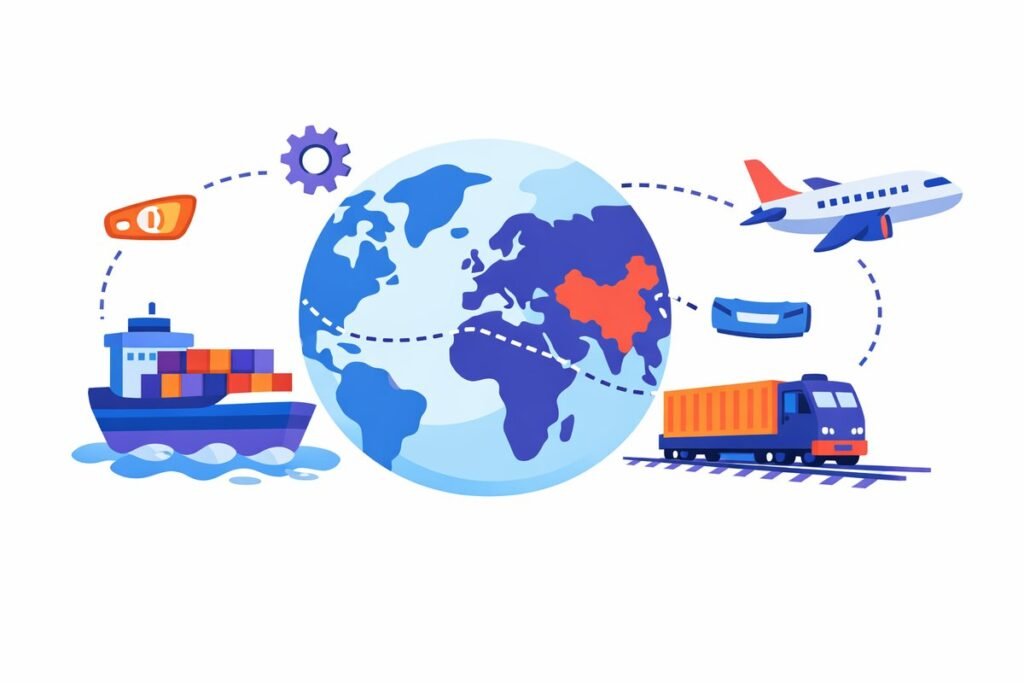
Buying auto parts from China is one thing. Getting them to your warehouse in Europe without overpaying or waiting forever — that’s a whole different challenge. I’ve shipped hundreds of orders for European clients over the past few years, and the shipping decision is where most first-time importers either save big or lose their margins.
Here’s a breakdown of the five main shipping methods, with real numbers and honest opinions on when to use each one.
1. Sea Freight — The Default for Large Orders
Sea freight is the most common method for shipping auto parts in bulk. A 20ft container from Guangzhou to Hamburg or Gdynia takes about 30-40 days, and you’re looking at roughly $1,200-2,500 depending on the season and carrier.
For heavy, bulky items like bumpers, body kits, and large lighting assemblies, sea freight is almost always the right call. The cost per kilogram is the lowest of any method, usually around $0.15-0.30/kg for a full container.
My take: if your order is over 2 cubic meters or 500kg, sea freight should be your first consideration. The downside is time — 5-6 weeks door to door once you factor in customs clearance and last-mile delivery. If you can plan ahead and keep buffer stock, this is where the money is.
One thing to watch: shipping lines have been more stable since 2024, but peak season (August-October) still pushes rates up 30-50%. Plan your orders around this if you can.
2. Rail Freight — The Sweet Spot for Medium Orders
China-Europe rail freight has become a serious option in the last few years. The route runs from Chinese cities through Kazakhstan and into Europe, with major terminals in Poland (Małaszewicze), Germany (Duisburg), and the Netherlands.
Transit time is 18-25 days — roughly half of sea freight. Cost sits between sea and air, typically $0.40-0.80/kg. For auto parts orders in the 200-2000kg range, rail often makes the most sense.
My recommendation: I suggest rail freight to most of my European clients, especially those in Poland and Germany. The transit time is reasonable, the cost is manageable, and the reliability has improved a lot. You get your parts 2-3 weeks faster than sea freight without paying air freight prices.
The catch: rail freight has weight and size limitations per container slot, so oversized items (like full body kits for SUVs) might not fit standard rail pallets. Check with your forwarder before committing.
3. Air Freight — When Speed Matters More Than Cost
Air freight from China to Europe takes 5-7 days. It’s fast, reliable, and expensive — typically $4-8/kg depending on the route and carrier.
For auto parts, air freight makes sense in two situations: urgent replacement orders (your client needs parts yesterday) and high-value, low-weight items like electronic control units, sensors, or small LED modules.
I’ve used air freight for rush orders when a client’s workshop had a car waiting. In those cases, paying $500 extra in shipping is worth it because the client keeps their customer happy. But for regular stock replenishment, air freight will eat your margins alive.
Pro tip: if you’re shipping by air, consolidate with other small shipments. Most freight forwarders offer consolidated air cargo that’s 20-30% cheaper than booking a standalone shipment.
4. Express Courier — Best for Samples and Small Parcels
DHL, FedEx, UPS, and SF Express can get a package from Guangzhou to anywhere in Europe in 3-5 business days. For packages under 30kg, this is often the simplest option.
Cost ranges from $6-15/kg, which sounds expensive — and it is for bulk orders. But for samples, small test orders, or urgent spare parts, express courier is unbeatable. No customs broker needed (the courier handles it), door-to-door tracking, and minimal paperwork.
My advice: order samples via express courier first. Spend $50-80 on shipping to verify fitment and quality before committing to a $3,000 sea freight order. That sample shipping cost is insurance.
One warning: couriers charge by volumetric weight, not actual weight. Auto parts like bumpers and headlight housings are bulky but light, so the volumetric calculation can double or triple your expected cost. Always ask for a quote with exact dimensions before shipping.
5. LCL (Less Than Container Load) — For Orders That Don’t Fill a Container
Not every order justifies a full 20ft container. LCL lets you share container space with other shippers, paying only for the volume you use.
Typical LCL rates from China to Europe run $60-120 per cubic meter, with transit times similar to full container sea freight (30-45 days, sometimes a bit longer due to consolidation).
LCL works well for orders in the 1-8 cubic meter range. Below 1 CBM, express or air might be cheaper. Above 8 CBM, you’re getting close to the cost of a full container anyway.
The downside of LCL: your cargo gets handled more. It’s loaded into a consolidation warehouse, packed with other shipments, then unpacked at the destination. For fragile items like headlights or chrome trim pieces, this extra handling increases the risk of damage. Make sure your supplier packs everything with extra protection — double boxing, foam inserts, corner protectors.
How to Choose: A Quick Decision Framework
Here’s how I help my clients decide:
- Under 30kg, urgent: Express courier
- Under 30kg, not urgent: Express courier (still simplest)
- 30-500kg: Compare air vs. rail based on urgency
- 500-2000kg: Rail freight (best balance of cost and speed)
- Over 2000kg or 8+ CBM: Sea freight (FCL if possible)
- 1-8 CBM, not urgent: LCL sea freight
The real trick is combining methods. Many of my clients use sea freight for their regular stock orders (planned quarterly) and keep express courier as a backup for urgent requests. This way, you get the best rates on 80% of your volume and only pay premium shipping when you absolutely have to.
Final Thoughts
Shipping costs can make or break your auto parts import business. The difference between choosing the right and wrong method on a single order can be $500-2,000 — and that adds up fast over a year.
My advice: build a relationship with a reliable freight forwarder who knows the China-Europe route. A good forwarder will suggest the best method for each order, handle customs documentation, and flag potential issues before they become expensive problems.
If you’re importing auto parts from China and need help with logistics, feel free to reach out to us. We handle shipping coordination for our clients as part of our sourcing service, and we’re happy to point you in the right direction.