How to Verify a Chinese Auto Parts Manufacturer Before You Wire the Money
A Polish client sent $14,000 to a supplier they found on Alibaba. Brake calipers, 400 sets, for a European distributor. The supplier had gold status, 5-star reviews, a slick product page. They wired the deposit. Three weeks later, the factory went quiet. No shipment, no refund, no response.
This isn’t rare. It happens more than people admit, and not just to newcomers.
I’ve been sourcing auto parts from Guangdong for over a decade. The verification process I use now is not what I started with. It changed after watching enough deals go wrong — suppliers who existed on paper but couldn’t produce, factories repackaging OEM seconds as Grade A, middlemen passing themselves off as manufacturers. The warning signs are there if you know where to look.
Start with the business license (business registration certificate, 营业执照). Every registered company in China has one. Any real supplier will send you a copy without hesitation. If they stall or make excuses, that’s already your answer.
Don’t just glance at it. Check the registered business scope (the list of approved business activities, 经营范围), the registered capital, and the registration date. The business scope tells you whether they’re licensed to manufacture or only to trade. A trading company listing “auto parts manufacturing” (汽车配件制造) in their scope when they clearly don’t have a factory is a common trick. Registered capital matters too — not because it tells you the actual cash they have, but a company with RMB 100,000 registered capital claiming to do $2M in annual exports doesn’t add up. It doesn’t mean they’re fraudulent, but it means you should push harder.
Cross-check the license against China’s National Enterprise Credit Information Publicity System (national business registry, 企业信用公示). It’s free, it’s in Chinese, and it shows you administrative penalties, litigation records, and whether the company is flagged as abnormal. I run this check every time.
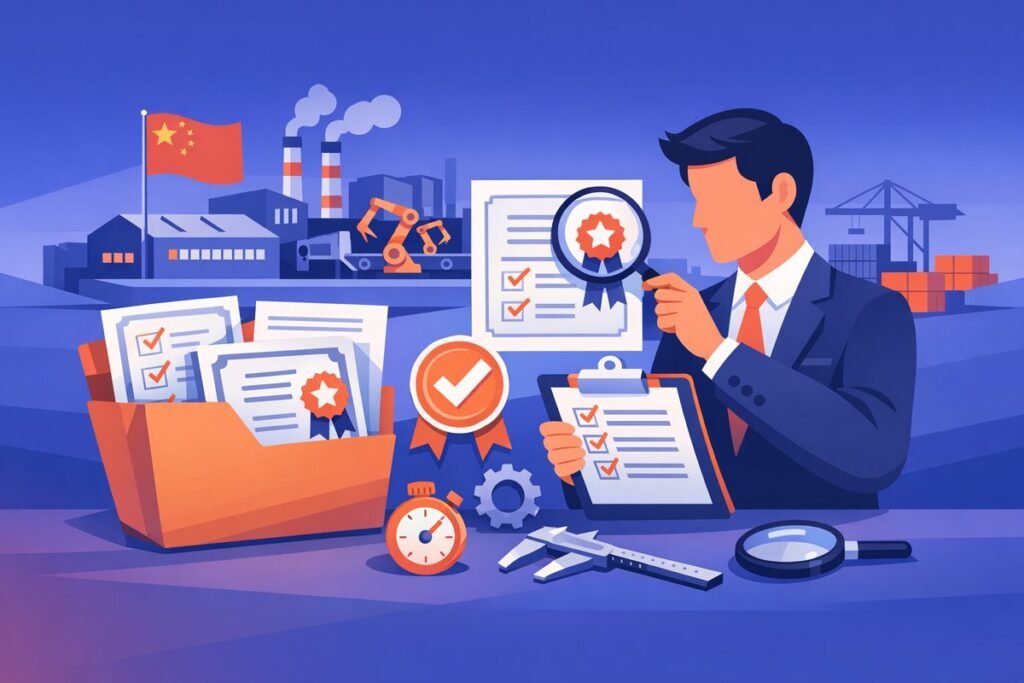
If the order is above $5,000, get a physical audit done. Either go yourself, or hire a local inspection company. SGS, Bureau Veritas, QIMA — all of them cover Guangdong, roughly $350–600 USD per day. Worth it.
You want to see production equipment that matches the products they claim to make, raw material inventory that’s actually being used, a QC area with people in it, and workers who can answer basic questions about their own parts. I’ve visited factories where the showroom was spotless and the production floor had three guys and a machine from 2003. That factory was quoting 5,000 sets per month.
If you can’t make the trip and don’t want to pay for a formal audit, at minimum video call them during working hours and ask to walk through the production floor. Any real factory will say yes on the spot. A trading company pretending to manufacture will come up with a reason why now isn’t a good time.
On certifications: suppliers will send you documents, and some of those documents are copied from other factories with the name swapped out. The IATF 16949 certificate includes an issuing body and certificate number. Search it at iatfcertipedia.org. Takes two minutes. I’ve caught three fake IATF certs this way — the suppliers had lifted someone else’s certificate and changed the company name. They were surprised I checked.
For ECE certifications, the approval number format is strictly defined. No approval number, or a number that doesn’t match the part category, flag it immediately.
Export history is underused. There are paid databases that pull Chinese customs data — ImportYeti, Panjiva, ImportGenius. They’re not cheap, but for a first large order with someone new, they’re worth running. You’re looking for evidence that the supplier has actually shipped auto parts before, to real buyers in real countries. If they claim regular shipments to Germany but show zero exports in the past 12 months, that’s a problem. ImportYeti has a free tier that’s often enough to confirm whether exports are real at all.
Payment terms also tell you something. Serious manufacturers don’t demand 100% T/T upfront from buyers they’ve never worked with. Some small factories genuinely need the cash flow to start production, so it’s not automatically a scam — but if something goes wrong, your protection is close to zero. I work with 30% deposit after PI, 70% against copy of Bill of Lading. For new suppliers I don’t know well, I push for inspection before the final payment. If they push back hard on this, it’s worth asking why.
A few things that look like red flags but usually aren’t: small factories with bad websites (most real manufacturers in Guangdong have terrible websites or none at all), different English and Chinese names (common — verify the unified social credit code, 统一社会信用代码, instead of matching by name), and trading companies (a good trading company with solid supplier relationships can be more reliable than going directly to a small factory with no export experience — the point is knowing what you’re dealing with, not assuming one is better than the other).
The verification process I’ve described takes maybe 2–3 hours per supplier. For most people moving $10K–$100K per order, that’s an obvious use of time. What I still don’t fully understand is how many buyers skip it — because the supplier seemed professional, or because the order needed to go in fast.
Once the money is gone, getting it back is a different kind of problem.