How to Import Auto Parts from China to Poland
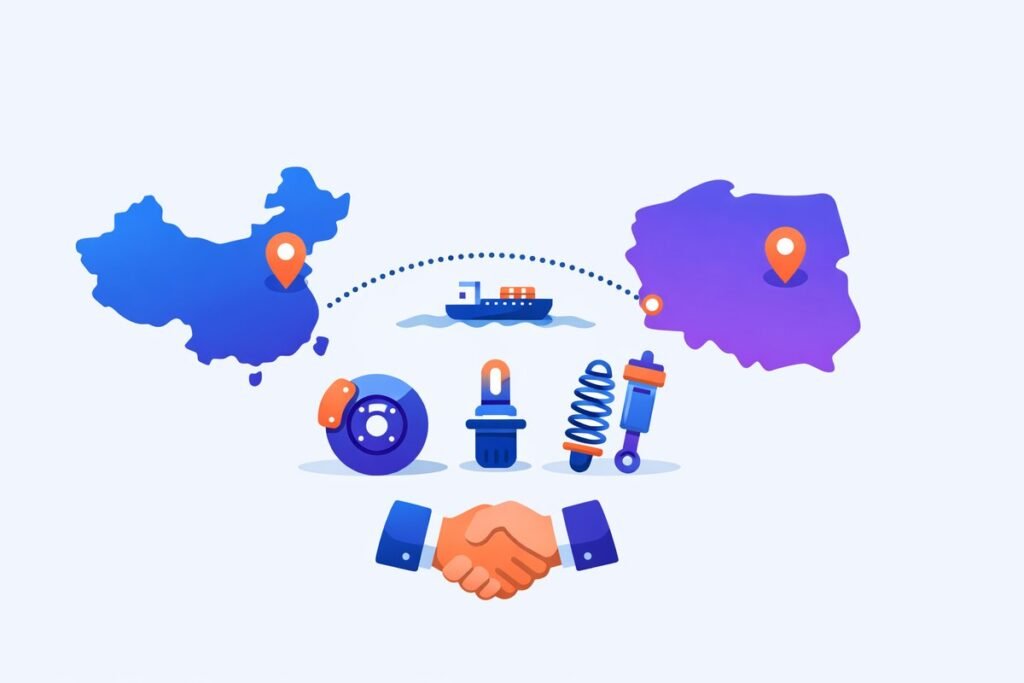
Poland’s automotive aftermarket has been growing steadily over the past few years. I’ve worked with shops, distributors, and online sellers who source brake pads, suspension parts, LED lights, and body kits from China — mostly because the pricing makes sense.
But it’s not as simple as finding a supplier on Alibaba and placing an order. There are steps that matter, and mistakes that cost money. Some are obvious. Some you only learn after getting burned once.
Here’s what actually matters if you’re importing auto parts from China to Poland.
1. Finding Suppliers (The Cheap One Usually Isn’t Worth It)
Most people start on Alibaba or 1688. That’s fine. But a listing doesn’t tell you much.
What I actually check:
– Can they handle your order size and timeline? Some factories say yes to everything, then ghost you when production starts.
– Have they shipped to Europe before? If they don’t understand CE marking or export documentation, you’ll be teaching them on your dime.
– How do they communicate? If they deflect technical questions or give vague answers about lead times, that’s a red flag.
The suppliers who quote significantly lower than everyone else usually have a reason. Sometimes it’s lower quality. Sometimes it’s hidden costs that show up later. Sometimes they’re just a trading company marking up someone else’s factory.
One trick that works: ask the same lead-time question twice, two weeks apart. Real factories give you the same answer. Trading companies change their story based on who they’re calling that week.
2. MOQ (Minimum Order Quantity)
Most Chinese suppliers have MOQs. For auto parts, it’s usually 50-100 pieces for standard stuff like brake pads or filters. Custom or OEM parts can be 500-1,000 pieces. Some will do 10-50 pieces for samples if you negotiate.
You can sometimes get them to lower the MOQ if you show you’re serious — share your business plan, website, or sales channels. Or offer to pay a slightly higher unit price for the first order. Or commit to repeat orders if the first batch sells.
A lot of suppliers will work with you if they think you’re not just testing the waters.
3. Samples (Don’t Skip This)
Never skip samples. It’s the cheapest insurance you can buy.
Check fitment first — does it actually fit the vehicle model it’s supposed to? Then quality — materials, finish, durability. And packaging — will it survive international shipping without arriving as a pile of broken parts?
Most suppliers charge for samples, usually 2-3x the unit price. Shipping via DHL or FedEx runs €30-80 depending on weight. Total sample cost is usually €100-200 for 2-3 parts.
If a supplier refuses to send samples, walk away. That’s not negotiable.
4. Shipping Methods
You have four main options:
Sea freight is the cheapest but slowest — €1,500-3,000 per 20ft container, 35-45 days port to port. Good for large orders (500+ kg) when you’re not in a rush.
Rail freight is the middle ground — €3-5 per kg, 18-25 days from China to Poland via Malaszewicze. This is what a lot of importers use for mid-sized orders (200-1,000 kg). Faster than sea, much cheaper than air.
Air freight is fast but expensive — €8-15 per kg, 5-10 days. Makes sense for urgent orders or high-value lightweight parts like LED lights or sensors.
Express courier (DHL/FedEx) is the fastest — €20-40 per kg, 3-7 days. Only worth it for samples or small urgent orders under 50 kg.
For regular shipments to Poland, rail freight is usually the sweet spot.
5. Import Duties and VAT in Poland
When your shipment arrives in Poland, you’ll pay import duty and VAT.
Import duty depends on the HS code. Auto parts (HS 8708) are usually 2.5-4.5%. LED lights (HS 8512) are 4.5%. Brake pads (HS 8708.30) are 2.5%.
VAT is 23%, calculated on product value + shipping + duty.
Here’s an example:
– Product value: €5,000
– Shipping: €500
– Duty (3%): €165
– VAT base: €5,665
– VAT (23%): €1,303
– Total landed cost: €6,968
For customs clearance in Poland, work with a local broker. They know the local regulations, HS code classifications, and customs procedures far better than anyone based in China. We handle the export side; they handle the import side. That’s the cleanest split.
6. Quality Control Before Shipping
This is where most importers lose money.
Wrong parts get shipped. Packaging gets damaged. Quality doesn’t match the sample. Documentation goes missing (CE certificates, packing lists).
You can prevent most of this with a pre-shipment inspection. Hire a third-party inspector (€200-400) to check your order before it leaves the factory. If you’re ordering regularly, visit the factory in person or send someone you trust. For large orders, use Alibaba Trade Assurance or a letter of credit.
If a supplier rushes you to pay the balance before inspection, slow down. That’s usually a bad sign.
7. Sourcing Agents (Sometimes Worth It)
If you’re new to importing or don’t have time to manage suppliers, a sourcing agent can help. They find and vet suppliers, negotiate pricing and MOQ, arrange samples and inspections, and handle shipping and documentation.
Cost is usually 5-10% commission on order value. Some charge a flat monthly retainer.
It’s worth it if you’re importing for the first time, ordering from multiple suppliers, or don’t speak Chinese. The good ones save you more than they cost.
8. Building Relationships
The best deals don’t come from switching suppliers every order. They come from building trust over time.
Pay on time (or early). Communicate clearly. Give feedback when something goes wrong, and when something goes right. Commit to repeat orders.
Suppliers give better pricing, faster lead times, and more flexibility to buyers they trust. It’s not complicated, but it matters.
What Actually Matters
Importing auto parts from China to Poland isn’t complicated, but it does require attention to detail.
The buyers who do well are the ones who take time to vet suppliers properly, don’t skip samples or inspections, understand the full landed cost (not just the unit price), and build relationships instead of chasing the lowest quote every time.
If you’re looking for help sourcing auto parts from Guangzhou, we work with Polish importers regularly. Feel free to reach out — no pressure, just happy to point you in the right direction.
Need help sourcing auto parts from China?
We’re based in Guangzhou and work with importers across Europe. Whether you need brake parts, LED lights, body kits, or custom accessories, we can help you find the right supplier and manage the process from sample to delivery.