Quick Summary: When deciding what to send for a Chinese auto parts quote, start with your current parts list, quantities and units, plus any reference numbers, photos or supplier links you have. Keep missing details visible and explain your destination and purchase timing as far as they are known. You can begin an inquiry before every specification is settled, but the quoted product and conditions must be clear before you approve purchasing. BuyFromGuangzhou can help organize the request and coordinate supplier clarification as part of your China-side purchasing and order fulfillment.
A mixed parts request can arrive as a spreadsheet, supplier screenshots and photos in separate messages. The quantity is clear, but the last character on one label is unreadable. Another item has two possible connector versions. Asking for a price is reasonable; treating every reply as a confirmed product would leave the buyer guessing what will actually arrive.
I would start by matching each requested part to its quantity and the evidence already available. You do not need to rebuild everything into a finished RFQ spreadsheet before contacting us about a planned purchase. The useful first step is to show what you need and which questions still need an answer.
Start with the parts and quantities you already have
Send your current list, the required quantity and unit for each part, and whatever helps identify it: an OE or manufacturer reference, a product link, photos, or relevant vehicle details. Explain whether this is a trial purchase or a replenishment batch, where the goods need to go, and any timing you already know. A delivery deadline that is still undecided can be marked as such.
The information needed to begin a conversation is different from the information needed to release a purchase. We can help organize an existing buying request, identify the gaps and coordinate supplier questions within the agreed service scope. Whether a particular part can be quoted depends on what the available evidence establishes.
Give every part a row you can find again
Use a unique buyer line ID, with your SKU alongside it when available. The distinction matters: the same SKU may appear twice because it needs different packaging or delivery dates. Each row should stay identifiable even if a supplier uses another code or changes its quotation order.
The example below shows how an incomplete request can be recorded. It is an illustrative entry, not a real customer order, a verified part specification or permission to purchase.
Buyer line ID A017 Part Left-side door mirror Quantity / unit 10 pcs Reference source Removed-part label; final character unclear Photos A017_label.jpg; A017_connector.jpg Open question Confirm the complete reference and required functions. Next action Supplier to identify the proposed version before quoting; buyer approval required before purchasing.
That row gives the supplier a specific question. A reply should identify the proposed version against A017, so the buyer can check the answer against the original label and photos. The unclear character stays open until it has been resolved.
Keep common information at the top of the RFQ: destination, overall timing, the China receiving address if needed, general packaging requirements and quotation scope. Each row then carries the part, quantity and unit, references, photos, required quality or specification, and any exception to those shared terms. Common requirements only need to be written once.
What to send for a Chinese auto parts quote: identify the version
Keep the reference and its source together
Copy the full OE or manufacturer reference as shown, including prefixes and suffixes, and state where you found it. A removed-part label, an earlier purchase record and an unconfirmed online listing are different sources of evidence. If a character is unclear, flag it and keep the original image rather than guessing a replacement.
Record variant details that could change the item: left or right, front or rear, voltage, connector pin count, mounting points or required functions. Use only the details relevant to that product. Ask the supplier to name its proposed reference and explain any alternate number it offers.
Use VIN and vehicle details where they help
For vehicle-specific parts, include the make, model, production year or range, engine or chassis details and market version where relevant. A VIN can help when the supplier has a reliable identification method; it may still need supporting part photos or configuration information. For other components, dimensions or an equipment model may be more useful.
A VIN, an OE reference or a matching-looking photo is not a fitment guarantee. Ask for the basis of a proposed application or cross-reference, and resolve relevant technical questions before buying. Record what was checked and by whom, so a buyer-provided number is never silently treated as supplier confirmation.
Make each photo answer an identification question
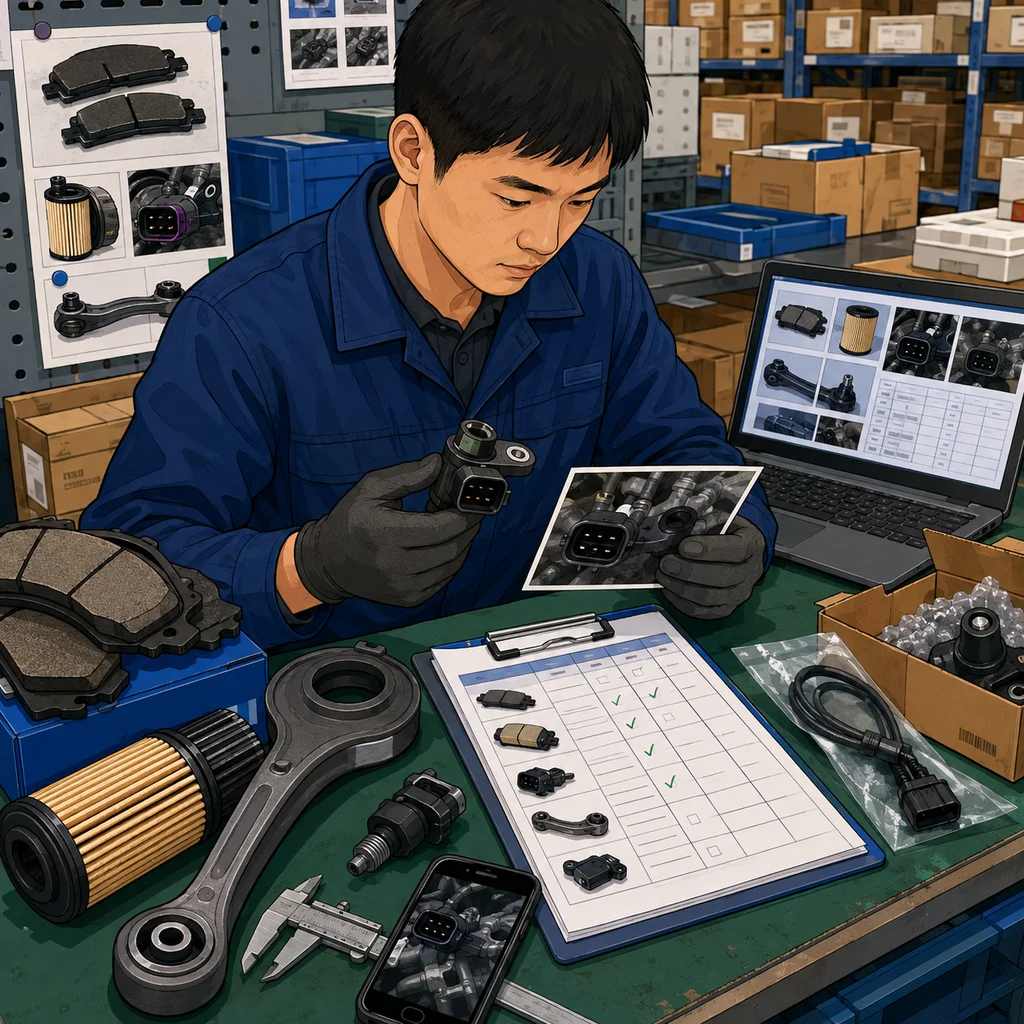
Keep the field list short and let the photos do their job. Useful views may include the complete part, a readable label, mounting points, connector shape and pins, or a ruler or caliper view where size distinguishes versions. Match each filename to its line ID, as in A017_label.jpg.
If your photos are still scattered through messages, keep their connection to the relevant part clear when sharing them. The aim is to let the supplier examine the disputed detail without guessing which item the image belongs to.
Write down what the quotation should include
Quantity needs a unit on every row. Pieces, pairs, sets and kits are different requests, even when the number beside them is the same. Identify any required quality or specification using a brand, material, approved sample or measurable requirement where relevant, and flag what remains undecided. A label such as "good quality" gives the supplier little to confirm.
Then state the quotation scope: goods only, goods delivered to a named China receiving address, or another specified handover point. Ask the supplier to show currency, packing inclusion, timing, payment terms and quotation validity. If it uses a trade term, the named place should be clear. The EXW vs FOB guide explains why the point where a supplier's responsibility ends changes what its price covers.
Get open questions answered before approving the purchase
I find a specific question and next action more useful than a vague "confirmed" label. "Buyer supplied the number; supplier to confirm connector version" tells everyone what is known and what work remains. It also avoids treating the source of a reference as proof that it is correct.
Some open questions allow a quotation with stated conditions. If a custom carton label is undecided, you can ask for a quotation based on the supplier's stated standard packaging, with custom labeling excluded or separately priced. The assumption belongs beside the quote and must be resolved if your purchase requires a different pack.
When the open question changes the product itself, ask the supplier to identify the candidate versions. If it can clearly describe and quote each option, keep those options separate, with their references, functions, prices and timing. The buyer may need those quotations to choose. An unidentified product still needs clarification before its price can be treated as a usable offer.
Before purchasing, the buyer must approve the selected option and its quantity, price and delivery conditions, with the relevant specification questions resolved. Receiving a quote or asking about an alternative is not approval to order it. Record the decision against the original row so an earlier option cannot accidentally become the purchase instruction.
Keep that row useful when the goods arrive
After approval, BuyFromGuangzhou can carry the same line ID, selected reference, quantity and agreed checking requirements into supplier purchasing and China-side receiving. When a carton arrives, we can match it to that row and record a shortage, unclear label or visible difference for a decision. Live Tracking shows receiving and checking progress; it does not replace technical confirmation or the agreed inspection. If your suppliers are already selected, the supplier-list handoff guide explains what to send for the next stage.
Start with your current purchase list
Planning an auto parts purchase from China? Use our Contact Form to paste a short parts list or supplier links, with quantities, destination and any known timing. Tell us what still needs checking and whether you have photos or a longer file to share during follow-up. We can discuss the purchasing and China-side execution support your order needs.
FAQ
Can I start an inquiry without a complete OE number?
Yes. Send the part description, quantity and unit, plus the references, photos or supplier links you have, and mark the missing characters. That can start clarification; a usable quotation still needs a sufficiently identified product.
Do I need a VIN for every part?
No. Include it when it helps establish a vehicle-specific application, alongside the relevant vehicle and part details. If it is unavailable, say so and provide other useful identification evidence; the supplier may still need further information.
Do I need to prepare a finished RFQ spreadsheet first?
No. You can begin with an existing parts list or a short message that pairs each item with its quantity and available references. For a planned purchase, BuyFromGuangzhou can help organize the information and coordinate clarification within the agreed service scope.
What if the supplier offers more than one option?
Ask it to identify and quote each option separately, showing the relevant differences and any unresolved questions. You can use those quotations to decide, but the selected product and conditions need your approval before purchasing.
What must be confirmed before I approve purchasing?
Confirm the selected product and version, quantity and unit, price, and the agreed packaging and delivery conditions. Resolve identification or specification questions that could change the item, and record which option you accept. Conditions used for an earlier reference quote should not silently become final order instructions.
How does the RFQ connect to Live Tracking later?
Once purchasing is approved, the same line ID can connect the supplier order, receiving record and any checking issue. Live Tracking makes those later stages visible, while the original RFQ preserves the references and requirements used to make the buying decision.