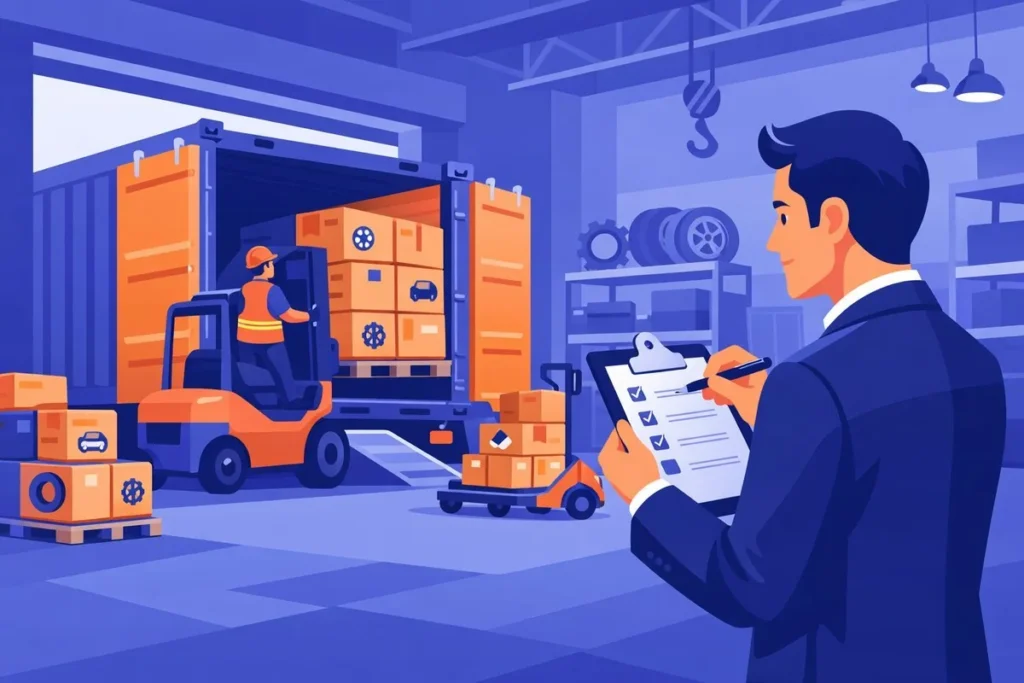
Quick Summary: China auto parts quality control is not one final look at sealed cartons. It is a series of release decisions between supplier dispatch and export: match each delivery to the order, check the agreed visible details, record anything unclear, and keep problem lines out of the ready batch. For mixed supplier orders, the buyer also needs to see what arrived, what passed the agreed checks, and what is still waiting for action. BuyFromGuangzhou uses receiving records, issue photos, and Live Tracking to make those decisions visible before forwarder handover.
A supplier says the brake pads are ready. Another supplier sends filters with a courier number. A third delivery reaches Guangzhou with a damaged outer carton and no useful carton mark.
From outside China, all three messages can sound like progress. Physically, they are three different situations. The first goods may not have left the supplier. The second carton has moved but has not been matched to the purchase list. The third needs to be identified and held before anybody treats it as export-ready.
That gap is where quality control matters. I do not think of it as a ceremony at the end of production. I think of it as a controlled answer to one question: what evidence is good enough to release this order line into the shipment?
China auto parts quality control starts when promises become physical goods
Supplier photos and messages are useful, but they are not the same as receiving and checking the goods. "Ready" may mean production is finished, packaging has started, the cartons are waiting for pickup, or simply that the salesperson expects the goods soon.
The buyer needs a chain that connects the purchase list to what is physically moving. We begin with the information the buyer already has: supplier links or names, quotation or purchase list, part references, quantities, packaging or label requirements, destination, and any urgent lines. From that, the order can be separated supplier by supplier and line by line before cartons arrive.
This is a narrower and more honest scope than claiming every carton has received laboratory testing. Some orders require a technical third-party inspection, functional test, material report, or factory visit under a separately agreed scope. Everyday order control still has to happen around that technical work: supplier follow-up, receiving, identity, quantity, visible condition, labels, packaging, issue records, and release status.
If those basic controls are missing, a passed inspection report can still sit beside the wrong carton, a short delivery, or a shipment that includes goods the buyer never approved.
The order line is the first inspection reference
When goods arrive, the carton should not become an anonymous box in a warehouse. It should be attached to a supplier, courier record, and expected order line.
For a mixed auto parts order, the useful reference is not only the supplier invoice total. The receiving record should show which item was expected, expected quantity, received quantity, carton count, visible model or OE reference where available, packaging requirement, and current status.
This is why I want the buyer's real purchase list before the first delivery. A screenshot of a supplier chat may show a price, but it often does not carry enough detail to control receiving. If the buyer has left and right parts, 12V and 24V variants, different connector types, neutral versus branded packaging, or several similar OE references, those distinctions must exist in the order record before anyone checks the carton.
Our article on receiving and checking goods from existing auto parts suppliers explains this handover in more detail. The basic judgment is simple: if the receiving team does not know the expected line, it cannot prove the delivered line is correct.
A delivered carton is not a checked order line
Courier tracking can prove that a parcel reached an address. It does not prove which purchase line is inside, whether the quantity is complete, or whether the label belongs to the part the buyer ordered.
When a carton arrives, we first identify the supplier and attach the delivery to the order record. We register the carton count and visible outer condition. Then the agreed check moves inward: quantity where the scope allows it, packaging, labels, model or OE reference, visible damage, missing accessories, and any buyer-specific marking requirement.
Not every order needs the same depth. A sealed standard carton may be handled differently from loose market parts, fragile lights, electrical units with several connector variants, or left/right suspension components. The important point is that the scope is agreed before checking, not invented after a problem appears.
A generic warehouse can tell the buyer, "three cartons received." A controlled receiving record should tell the buyer which supplier sent them, which lines they relate to, what was checked, what remains unclear, and whether they are held or ready.
Auto parts need method-based checks, not a generic “looks good”
Auto parts can look almost identical while the useful reference is different. Saying "we check the model" is too vague. The method matters.
For an OE reference, we read the number from the label, packaging, or part where it is visible, then match it to the buyer's order line. For left and right parts, we may need the OE suffix, part-number marking, shape, mounting direction, or a buyer-verified reference image. For electrical variants, connector shape, pin count, voltage marking such as 12V or 24V, and function notes such as heated or folding may separate the correct line from the wrong one.
Door parts and similar categories often need two layers. First, match the visible OE or product reference to the order. Then compare the physical part with the buyer's verified image and the supplier's provided photo where useful. This does not turn a visible check into an engineering test, but it catches the common problem of a correct-looking label sitting on the wrong variant.
Packaging also carries product information. A missing side label, unclear inner-box quantity, wrong neutral or branded box, or inconsistent carton mark can break the buyer's own receiving and sales work even when the part itself appears normal. The current article on packaging, labels, and carton marks shows why those details belong to order control rather than decoration.
When one detail is wrong, hold the line
The easiest way to make a checking process meaningless is to find a problem and then let the goods move anyway.
If received quantity is short, we compare it with the expected line, record the shortage, photograph useful evidence, and ask the supplier to resend, explain, or credit it. The buyer can then decide whether to wait, split the shipment, or move the confirmed goods first.
If the model or reference is unclear, that line is held. Photos go to the supplier or buyer with the exact question that needs a decision. If a carton has no useful mark, we trace it through the courier record, supplier response, item appearance, and purchase list before it joins any batch.
If the outer packaging is damaged, the first task is to show the condition clearly and judge whether the issue appears limited to the carton or may affect the product. Repacking, supplier replacement, further inspection, or release depends on what the evidence shows and what the buyer confirms.
We prefer to show the real status as soon as the issue is identified during receiving or checking, usually the same working day, rather than promise a fake fixed response time. The important control is that unclear goods do not quietly change from "issue pending" to "ready for shipment."
Photos matter only when they support a decision
Ten random warehouse photos can create the feeling of activity without proving anything. Useful photo evidence belongs to a specific supplier, order line, issue, and decision.
A shortage photo should help show the counted quantity or packing condition. A wrong-item photo should show the relevant label, OE reference, connector, side marking, or physical difference. A damaged-carton photo should show the affected area and enough surrounding context to understand what arrived.
The record then needs a next step: supplier checking, buyer confirmation, resend requested, repack requested, held for technical inspection, approved for release, or moved to a later batch. Photos are evidence inside the process. They are not the process by themselves.
This is also how an importer should read a report. A long PDF is not automatically strong evidence. The question is whether the findings connect to the actual purchase lines and release decisions. Our guide to reading a Chinese auto parts inspection report focuses on that distinction.
Live Tracking should show release status, not just delivery status
For a buyer outside China, quality control becomes useful when the order status is visible before export.
Our Live Tracking and order dashboard can show supplier movement, received quantity, carton count, checking status, issue notes, photo evidence, consolidation status, document preparation, and shipment readiness. The dashboard does not replace checking or technical inspection. It shows what work has actually been completed and what still blocks release.
I would rather see six honest statuses than one green "delivered" mark. Received means the goods reached us. Checking means the agreed review is still happening. Issue pending means the line is held. Ready for consolidation means the agreed checks passed or the buyer approved release. Handed over means the confirmed batch moved to the shipping side.
That visibility helps the buyer decide. If four suppliers are ready and one problem line is waiting for replacement, the buyer can choose whether the replenishment shipment should leave or wait. Without those statuses, the buyer is making a freight decision from supplier chat messages.
The final quality question is what joins this shipment
By the time cartons reach the forwarder, the buyer should already know what is inside the batch and what was deliberately held back.
Before handover, we compare the release status with the shipment plan. The confirmed goods should connect to the product descriptions, quantities, carton count, packaging records, and other information needed for the packing list, invoice, and export preparation. A supplier's own packing list is not automatically the final record for a consolidated shipment.
One supplier may ship short. Another line may wait for replacement. Several inner boxes may be repacked into a stronger outer carton. The export information should follow the goods actually released, not the quantities everybody hoped would arrive.
Quality control ends with a commercial decision, not a photo folder. The buyer knows which lines are confirmed, which issues remain open, what enters this shipment, and what the forwarder is receiving.
Ask who owns the gap before you pay
Before placing the order, ask who will receive the goods, match cartons to order lines, check the agreed details, record shortages or unclear references, hold problem lines, collect decision-ready photos, update the buyer, and control release to consolidation.
Also ask what is outside the normal scope. Technical testing, dismantling, installation simulation, laboratory analysis, certification verification, and factory-process inspection may require separate arrangements. A clear boundary is more useful than a provider promising to "check everything."
For a single low-risk product from one proven supplier, the buyer may be comfortable with a narrower check. For mixed-SKU, multi-supplier, electrical, left/right, fitment-sensitive, or recurring replenishment orders, the local execution layer becomes harder to remove. Somebody still has to connect supplier movement, physical goods, issue evidence, buyer decisions, and shipment release.
Send the order you want controlled
If you already have supplier links, quotations, or a purchase list, send them through our Contact Form. Include item or OE references, quantities, supplier names, packaging or label requirements, destination, timing, and any lines that need a deeper inspection scope.
BuyFromGuangzhou can define the receiving and checking plan, register supplier deliveries, match cartons to order lines, record visible issues, coordinate supplier correction or additional inspection, keep problem lines on hold, update Live Tracking, consolidate confirmed goods, and prepare a clear handover before the cargo leaves China.
FAQ
What does China auto parts quality control include?
It can include supplier follow-up, receiving records, quantity and carton checks, visible condition, OE or model reference checks, packaging and label checks, issue photos, and release status. Technical testing or factory inspection should be defined separately when the order needs it.
Is a pre-shipment inspection enough for auto parts?
Not always. A pre-shipment inspection can be useful, but the buyer still needs to know whether the inspected goods match the purchase lines, whether all supplier deliveries arrived, what issues were held, and what confirmed goods enter the final shipment.
How do you check OE numbers and left/right auto parts?
We read the visible OE or part reference from the label, packaging, or part and match it to the buyer's order line. Left/right confirmation may also use suffixes, part markings, shape, mounting direction, or a buyer-verified reference image where available.
What happens if a supplier sends the wrong part or short quantity?
The affected line is recorded and held, with photo evidence when useful. We ask the supplier or buyer for the required decision, update the status, and release the goods only after the correction or approval is clear.
Can Live Tracking replace an auto parts inspection?
No. Live Tracking does not inspect a product. It shows what arrived, what was checked, which issue is pending, what evidence is available, and whether the buyer has released the line for consolidation and shipment.
What should I send before goods start moving in China?
Send supplier links or names, quotation or purchase list, item and OE references, quantities, packaging or label requirements, destination, timing, and any technical inspection requirement. That gives the China-side team a real order record to check against.