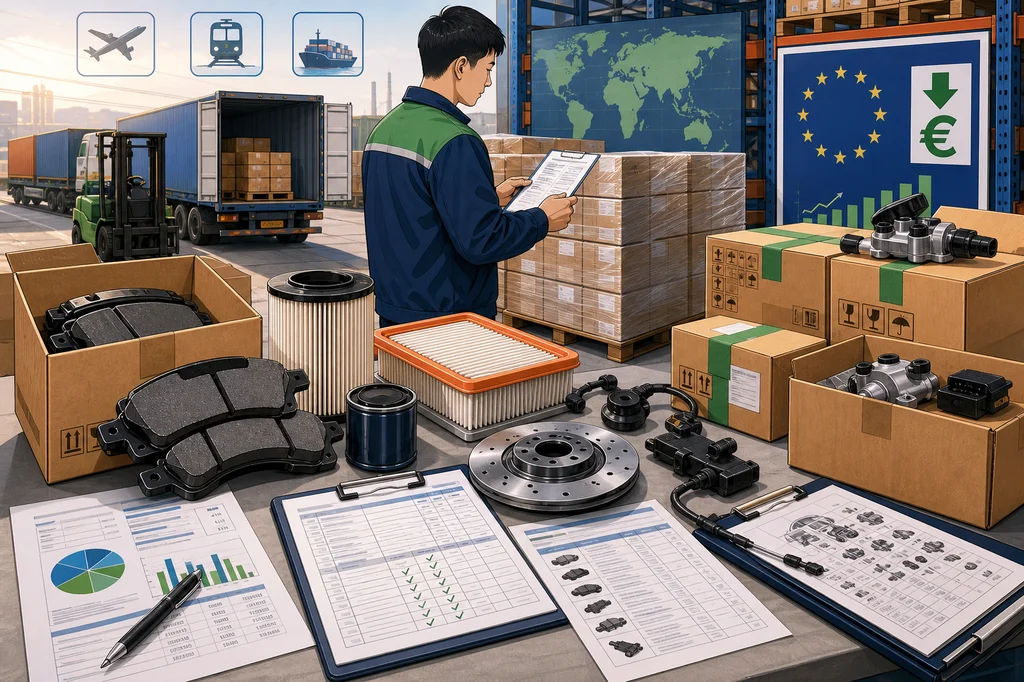
Quick Summary: The EU customs duty threshold 2026 change matters most to auto parts importers who send many low-value parcels or mixed small orders from China into Europe. As of July 1, 2026, the EU applies a flat €3 customs duty per product category, not per parcel, on consignments valued at €150 or less. For mixed auto parts orders, the practical work is not trying to hide value or change HS codes. The work is to control the order before export: confirm what has arrived, classify goods honestly, reduce unnecessary parcel splitting, prepare clean documents, and decide whether air, rail, sea, or a combined shipment plan gives the buyer a better landed-cost result.
A small auto parts order can look harmless when each supplier invoice is below EUR150. One seller ships sensors. Another sends filters. A third supplier has brake pads ready but still waits for packaging. If the buyer lets every supplier send separately, the order may arrive in Europe as many small parcels, each with its own customs data, product category, handling process, and possible extra charge.
That is the part I would not ignore after the EU customs duty threshold 2026 change. The question is no longer only, "Is this parcel under EUR150?" A serious importer now has to ask a harder question: "Is my China-side order being prepared in a way that makes landed cost, customs data, and shipment control clear before export?"
The rule is about low-value parcels, but the lesson is bigger
The July 2026 change is aimed mainly at low-value e-commerce parcels entering the EU from outside the bloc. It does not mean every B2B auto parts shipment is treated the same way as a consumer parcel from a marketplace. But many small importers are close to that border in practice. They buy mixed parts from several Chinese suppliers, split urgent lines, ship small quantities, and sometimes use parcel channels because each individual order looks small.
That pattern is where the cost pressure appears. Because the €3 duty is applied by product category, five different categories in one consignment can still mean five chargeable category lines. If the same goods are also split across several supplier parcels, the buyer adds more customs handling, more courier processes, and more chances for unclear HS code data. The buyer may think the supplier saved time by sending immediately. In reality, the buyer may have created a more expensive and harder-to-control import pattern.
I do not see this as a tax trick. The goods still need correct value, correct product description, correct HS code judgment, and honest documents. The real decision is whether the order should leave China as scattered parcels or as a controlled shipment batch.
There is also discussion around a separate €2 handling fee, but I would not write that into the landed-cost calculation as confirmed policy yet. Treat it as still under negotiation, with no confirmed effective date, until the final rule and carrier implementation are clear.
Auto parts orders are easy to split badly
Auto parts importers often buy by urgency. A customer needs one sensor quickly. Brake pads can wait. Filters are cheap but bulky. Electrical parts are small and easy to put in a parcel. A supplier may suggest shipping today because it makes their part of the order look finished.
From inside China, I would separate supplier convenience from importer cost. Supplier convenience says, "I can send this parcel now." Importer cost asks, "What happens when all these parcels arrive in Europe with separate customs handling, separate product descriptions, and different HS or category lines?"
For mixed aftermarket orders, the buyer should not decide shipment method before seeing what has physically arrived. A China-side team should first receive the goods, match them to the purchase list, check basic visible details, identify held or missing lines, and then decide which lines should move together. That is where China auto parts consolidation becomes a landed-cost control step, not just warehouse storage.
HS code discipline matters more after the threshold change
When low-value parcel charges become more visible, bad product naming becomes more expensive. A carton marked only as "auto parts" is weak. A packing list with vague product names is weak. Several unrelated parts under one loose description may pass from supplier chat to courier label, but it can create trouble when the goods reach customs.
For auto parts, I want the order list to separate product identity before shipment: brake pads, filters, sensors, switches, bearings, lamps, body parts, suspension parts, or other clear lines. The exact HS code decision depends on the product and destination customs handling, and BuyFromGuangzhou is not a customs authority. But we can help prepare cleaner China-side records: product name, quantity, supplier line, carton count, visible label, declared description, and the document set that the buyer or forwarder can review.
This is not about forcing one code to reduce charges. That would be the wrong frame. The better frame is: if the shipment contains several different product types, know that before export, document it cleanly, and avoid discovering the problem only after the parcel has already entered Europe.
Consolidation should happen after checking, not before
Some buyers hear "consolidation" and think it only means putting all cartons together. That is too simple for auto parts.
Before we combine goods, we need to know what arrived from each supplier. A filter carton may arrive complete. A sensor line may be short. A supplier may send the wrong left/right part. A small electrical item may have the same shape but a different connector or voltage label. If these goods are mixed into one outbound batch without checking, the buyer only moves the problem from China to Europe.
Our normal order movement is practical. We receive supplier goods, identify the carton, match quantity and order line, check visible packaging or label information where possible, mark shortages or unclear items, and update the buyer before release. If one line is not clear, it can be held. If the rest is ready, the buyer can decide whether to wait, split, or move the confirmed goods.
That decision is more important after the EU customs duty threshold 2026 change because shipment structure affects landed cost. A messy split can create more parcel-level friction. A blind consolidation can create customs and inventory confusion. A controlled batch gives the buyer a real decision.
Live Tracking should show the customs preparation stage
Many buyers think tracking starts after international dispatch. For this type of order, tracking should start earlier.
Live Tracking should show what has arrived, what is still missing, what has been checked, what is held, and what is ready for document preparation. If a buyer wants to reduce unnecessary parcel splitting, they need to see that information before the forwarder receives the cargo.
A useful auto parts order dashboard in China can also show shipment-readiness status. The buyer can see whether the current batch is ready for air, whether heavier goods should wait for rail or sea, whether several suppliers should be combined, or whether one urgent line should move separately. This is visible execution, not software decoration.
The shipping method should fit the confirmed goods
The threshold change can make buyers focus too much on the parcel charge itself. I would look at the whole shipment decision.
Air can make sense for urgent, high-value, small-volume parts. Rail or sea may make more sense for heavier replenishment stock, bulky cartons, or planned repeat orders. A combination can also be reasonable: urgent confirmed parts move first, lower-urgency goods wait for the next consolidated batch. The wrong move is choosing a route while supplier goods are still scattered and the order list is not clean.
For European auto parts importers, shipping auto parts from China to Europe should come after receiving, checking, consolidation judgment, and document preparation. A forwarder can move cargo. The buyer still needs someone in China to make sure the cargo being handed over is the right batch.
Export documents should match the order, not the supplier chat
When goods come from several suppliers, documents can become inconsistent. One supplier uses a Chinese product name. Another uses a broad English name. A courier label may have a short marketplace description. The buyer may have their own SKU or OE reference. If nobody reconciles these before shipment, the destination-side paperwork can become harder than necessary.
For BuyFromGuangzhou work, export preparation is tied to the physical order. We look at what has actually arrived, which cartons are released, what product lines are included, and what the buyer or forwarder needs for the shipment. That can include commercial invoice support, packing list preparation, carton count, product descriptions, and coordination with the shipping side under the agreed scope.
The article on China auto parts export documents explains this wider point: documents are not a separate office task. They should reflect the real goods that have been received, checked, consolidated, and released.
What I would check before November 1, 2026
November 1, 2026 is not just a vague next enforcement stage. That is when Product Identifiers become mandatory in customs data for these low-value consignments. Before that date, I would not wait for the first expensive delivery surprise. A European auto parts importer should check the current China shipping pattern now.
Start with parcel count. How many low-value parcels are leaving China each month? Then check product category count. Are many different part types being mixed or split without a plan? Then check HS-code and document discipline. Are product descriptions clear enough for your forwarder or customs broker to review? Then check whether suppliers are shipping directly because it is truly better, or simply because nobody is controlling the middle.
Finally, check the order rhythm. If you buy repeat auto parts from China, a planned dispatch rhythm may be stronger than many small supplier-by-supplier shipments. The rhythm does not have to be air freight only. It can be air, rail, sea, or a suitable combination depending on your stock pressure, margin, destination, carton volume, and urgency.
The practical buyer decision
The EU customs duty threshold 2026 change does not remove the need to buy from China. It changes the cost of being disorganized.
If your auto parts order is already controlled in China, the change is manageable. You know what suppliers shipped, what arrived, what is missing, what HS or product categories need review, what can be consolidated, and what should be handed to the forwarder. If your order is scattered across supplier parcels, you may only see the real cost after the goods reach Europe.
That is why I would treat this as a China-side execution issue, not only a customs news item. The buyer who already has suppliers, quotations, or replenishment plans needs a team to receive, check, consolidate, document, and coordinate shipment before export. That is where BuyFromGuangzhou can help.
Send your shipment pattern for review
If you are buying auto parts from Chinese suppliers and the EU customs duty threshold 2026 change may affect your parcel or replenishment cost, send your supplier list, shipment frequency, product categories, rough HS-code list if you have one, destination country, and current parcel or carton pattern through our Contact Form.
We can review the China-side execution scope: what should be received, checked, consolidated, documented, and dispatched as one batch or split into planned shipments. The goal is not to avoid customs rules. The goal is to stop uncontrolled supplier parcels from deciding your landed cost for you.
FAQ
What changed in the EU customs duty threshold in 2026?
As of July 1, 2026, the EU applies a flat €3 customs duty per product category, not per parcel, on consignments valued at €150 or less. This means importers should no longer build a China shipment plan around the old EUR150 duty-free advantage.
Does the 2026 threshold change affect auto parts from China?
It can affect auto parts importers who send many small low-value consignments, direct-to-consumer orders, mixed product categories, or supplier-by-supplier shipments from China to Europe. From November 1, 2026, Product Identifiers are also expected to become mandatory in the customs data, so product identity and document discipline matter before the goods leave China.
Can consolidation reduce the impact of the new EU parcel charges?
Consolidation can help when it reduces unnecessary supplier-by-supplier parcel splitting and creates a cleaner shipment batch. It should not be used to hide product categories or misstate HS codes. The right method is honest classification, clean documents, and a planned shipment structure.
Should I change HS codes to reduce the charge?
No. HS codes and product descriptions should reflect the real goods. The better approach is to identify product categories before export, prepare accurate documents, and decide whether the confirmed goods should move together, separately, or in a planned replenishment rhythm.
What should I send BuyFromGuangzhou for a landed-cost impact review?
Send your supplier list, product categories, shipment frequency, parcel count, carton pattern, destination country, rough HS-code list if available, and current shipping method. If goods are already moving, also send domestic tracking numbers and supplier delivery status.
Is air freight the only solution after the EU threshold change?
No. Air freight is only one option. Depending on urgency, weight, volume, margin, and replenishment timing, the better plan may be air, rail, sea, or a suitable combination after goods are received, checked, consolidated, and documented in China.