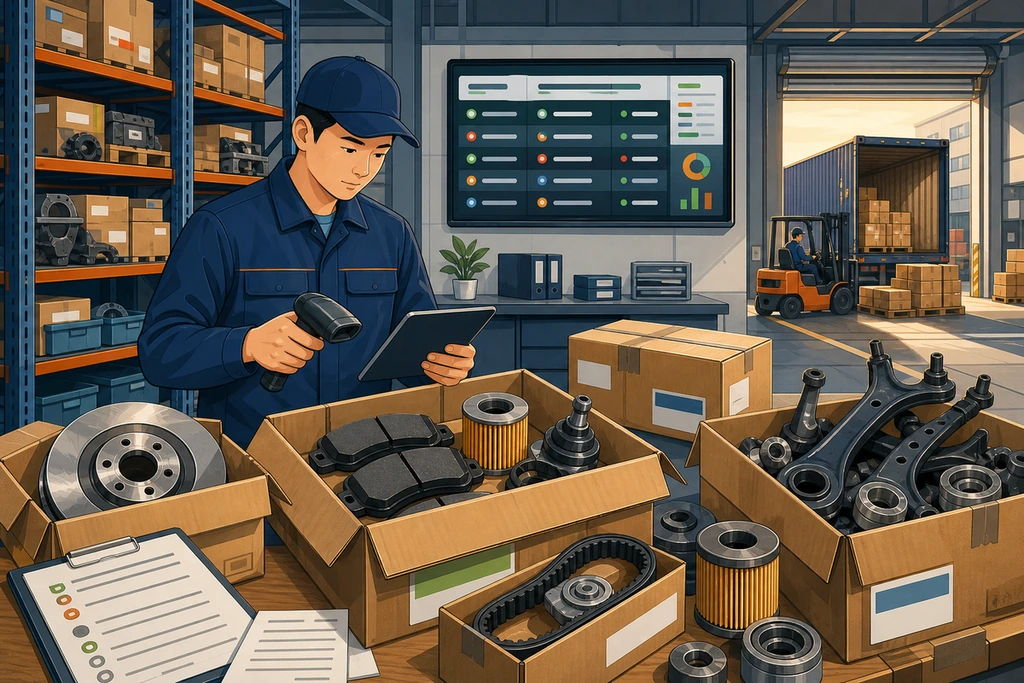
Quick Summary: An auto parts order dashboard in China should show more than whether a supplier has shipped or a carton has arrived. It should show supplier-by-supplier movement, expected quantity, received quantity, carton count, checking status, issue notes, photo evidence, consolidation status, document preparation, and shipment readiness. For buyers managing goods from China, the dashboard is useful only when it helps them decide what can move, what must wait, and what needs action before handover.
A buyer may already have supplier links, quotations, and an active purchase list. Payment is made. Suppliers start moving at different speeds. One sends tracking quickly. One says the goods are ready but does not dispatch. Another sends cartons with a mark that does not match the purchase list. From outside China, the buyer can easily receive many updates and still not know the real order status.
This is why I do not treat an order dashboard as decoration. A dashboard that only says pending, shipped, or delivered is still too weak for auto parts fulfillment. The buyer does not only need a tracking number. The buyer needs to know whether the goods are becoming a clean shipment.
An auto parts order dashboard in China should start from the order list
The first thing I want to see is not a warehouse address. I want to see the buyer's actual order structure. Which supplier is responsible for each line? What quantity is expected? Is the unit piece, pair, set, carton, or mixed packing? Are there OE references, buyer part numbers, left/right notes, connector details, voltage labels, packaging requirements, or urgent SKUs?
If the dashboard does not begin from that order list, every later update becomes loose. A courier delivery can arrive, but nobody knows which order line it belongs to. A supplier can say ready, but the buyer cannot see whether it means production ready, packed, domestic shipped, checked, or ready for export handover.
For buyers who already have suppliers, this is the practical value of auto parts order fulfillment in China. The China-side team turns supplier messages and arriving cartons into a controlled execution record.
Supplier status must be separated from warehouse status
Supplier status and warehouse status are not the same thing. This is one of the most common places where overseas buyers lose visibility.
A supplier may say the goods are ready. That does not mean the goods have been dispatched. A courier number may exist. That does not mean the carton has arrived. A carton may arrive. That does not mean the quantity, label, model reference, or visible condition has been checked. A checked line may still not be ready for shipment if the buyer is waiting for another supplier or if documents are not prepared.
So a serious dashboard should show these stages separately. Supplier preparing. Domestic shipped. Received. Checking. Issue pending. Ready for consolidation. Document preparing. Ready for handover. Handed over. These are not fancy software labels. They are the real movement of an order through China.
What the buyer should see for every supplier line
For an auto parts order, every supplier line should carry enough information for the buyer to understand what is happening without chasing the supplier again. The dashboard should show supplier name, item or SKU reference, expected quantity, received quantity, carton count, current status, issue note, and the next action.
When goods arrive, we match the carton to the supplier and order line. If the outside mark is clear, we record it. If the mark is unclear, we hold it and identify it through courier information, supplier confirmation, photos, item appearance, or the buyer's purchase list. A carton should not quietly join the ready batch just because it physically arrived.
This is also why receiving goods from China suppliers for auto parts orders has to connect directly with the dashboard. Receiving is not finished until the buyer can see what was received and what still needs confirmation.
Checking status should explain the decision, not only the result
Some dashboards show one word: checked. That is not enough. Checked for what? Quantity? Visible packaging? OE label? Left or right side? Connector shape? Pin count? 12V or 24V label? Accessory set? Carton damage?
For auto parts, the checking status should tell the buyer what was actually looked at under the agreed scope. If we can see an OE number on the label, packaging, or part, we match it to the order line. If the part is side-specific, we look for part-number suffix, shape, mounting direction, or the buyer's verified image. For electrical parts, connector shape, pin count, and voltage label can matter. For door parts and similar items, I prefer a two-layer check where possible: reference number first, then physical comparison against the buyer's verified image and the supplier's photo.
This does not turn a dashboard into a laboratory inspection report. It makes the warehouse decision visible. The buyer should know whether the line is ready, held, short, wrong, unclear, damaged, or waiting for confirmation.
Issue notes and photos are not optional for unclear goods
Normal lines move quickly. Problem lines need control. A dashboard becomes useful when it records the problem early enough for the buyer to make a decision.
If the supplier ships short quantity, the shortage should be shown against the order line. If a label is unclear, the dashboard should show that the line is held. If a left/right part does not match the purchase note, it should not be released into the shipment. If an outer carton is damaged, the note should separate simple carton damage from possible product damage and show whether supplier repacking, replacement, or buyer confirmation is needed.
Photo evidence matters here. Not random photos. Evidence inside the process. Wrong item, shortage, unclear model, damaged carton, missing accessory, anonymous carton, or packaging change should be photographed and tied to the order line. Then the buyer can decide whether to ask the supplier to resend, accept a credit, replace the line, split the shipment, or move confirmed goods first.
Live Tracking should make execution visible while decisions still matter
Live Tracking is useful only if it reflects real work on the ground. It should not be a polished screen that hides the messy middle. Buyers need to see which supplier is late, which carton arrived, which item is under checking, which issue is waiting for confirmation, and which goods are ready for the next shipment cycle.
When we update an order dashboard at BuyFromGuangzhou, the goal is not to make the buyer admire the system. The goal is to reduce blind decision-making. If the buyer sees that urgent sensors arrived and were checked, but heavier suspension parts are still waiting, the buyer can decide whether to ship one batch first or wait for a larger consolidation. If one supplier is delayed, the buyer can decide whether to chase, replace, split, or postpone that line.
That is the difference between visibility and decoration. Visibility lets the buyer act while the goods are still in China.
Consolidation and shipment readiness need their own status
A received carton is not automatically ready for consolidation. A checked carton is not automatically ready for handover. Before shipment, the dashboard should show which goods are joining the batch, which goods are held, which goods wait for another supplier, and whether the export documents can match the confirmed goods.
This is especially important for buyers using several suppliers. One supplier may ship small electrical parts. Another may ship bulky suspension parts. Another may delay filters or service items. The buyer's commercial question is not only whether each supplier sent goods. The question is whether enough confirmed goods are ready to become a useful outbound shipment.
A proper China auto parts consolidation process should connect receiving, checking, issue holds, packing records, documents, and shipping coordination. Air, rail, sea, or a suitable combination can all make sense depending on urgency, weight, volume, and the buyer's replenishment plan. But the transport decision should come after the order status is clear.
A dashboard should show what is ready to hand over
Before a forwarder or shipping side receives the cargo, the buyer should already know what is inside the batch. The dashboard should not leave this until the last minute.
For each ready batch, the buyer should be able to see confirmed supplier lines, carton count, quantity status, held items, issue decisions, packing or label notes, document preparation status, and handover plan. If something is missing, the dashboard should show whether it is deliberately held for the next shipment or still waiting for supplier action.
This is where a dashboard becomes a business tool. It helps the buyer serve their own customers. Stock that is urgent can move. Goods that are unclear can wait. Documents can be prepared against confirmed goods instead of guesses. The buyer is not forced to make shipment decisions from scattered chat messages.
What a weak dashboard usually hides
A weak dashboard often looks simple, but the simplicity can hide too much. It may show delivered without saying which supplier delivered. It may show checked without saying what was checked. It may show ready without showing whether missing lines were excluded. It may show shipped without showing what was deliberately held back.
For a single simple order, that may be enough. For mixed auto parts orders, it is not. Buyers running small-batch or repeat replenishment need a clearer operating view. They need to know where the order stands supplier by supplier and shipment by shipment.
This is why I would rather see a dashboard with honest status than a neat screen that says everything is fine. In real China-side fulfillment, some lines arrive early, some lines arrive late, and some lines need confirmation. The dashboard should show that reality clearly.
What buyers should ask before choosing a fulfillment partner
Before handing an order to a China-side team, buyers should ask what the dashboard actually shows. Not only whether there is tracking. Ask whether the dashboard connects to receiving, checking, issue handling, consolidation, documents, and shipment handover.
- Can each supplier line be matched to expected and received quantity?
- Can the buyer see carton count, checking status, issue notes, and photos?
- Are unclear or wrong goods marked as held instead of released quietly?
- Can the dashboard show which goods are ready for consolidation?
- Can shipment readiness show document and handover status?
- Can the buyer see what is excluded from the current batch and why?
These questions are more useful than asking whether the provider has a warehouse. A warehouse receives boxes. A fulfillment team should control the order movement behind those boxes. If you are comparing options, also look at whether the provider has practical China warehouse service for auto parts importers or only a delivery address.
Send the current order if you need dashboard visibility
If you already have supplier links, quotations, purchase lists, or goods moving inside China, the useful first step is to review what needs to be visible. We can look at the supplier list, expected quantities, urgent SKUs, checking points, consolidation plan, document needs, and shipment direction.
Send your current order through our Contact Form. BuyFromGuangzhou can review whether your order needs a simple receiving record or a more controlled auto parts order dashboard in China with Live Tracking, issue handling, consolidation status, document preparation, and shipment handover visibility.
FAQ
What should an auto parts order dashboard in China show?
It should show supplier name, order line, expected quantity, received quantity, carton count, checking status, issue notes, photo evidence, consolidation status, document preparation, and shipment readiness before handover.
Is a tracking number enough for auto parts orders from China?
No. A tracking number shows parcel movement, but it does not prove the carton belongs to the right order line, quantity is correct, labels match, goods are checked, or the shipment is ready for export handover.
How does a dashboard help when buying from several Chinese suppliers?
It separates each supplier line and shows what arrived, what is missing, what has an issue, what is ready for consolidation, and what should wait. This helps the buyer decide whether to wait, split, or move ready goods first.
Should issue photos be included in the order dashboard?
Yes. Photos should be attached when goods are short, wrong, damaged, unclear, unidentified, missing accessories, or different from the buyer's reference. They work as evidence for supplier or buyer decisions.
Can a dashboard replace inspection?
No. A dashboard does not replace technical inspection. It makes the agreed receiving, checking, issue handling, consolidation, document, and shipment status visible so the buyer can make better decisions before goods leave China.
Can BuyFromGuangzhou set up order dashboard visibility for existing suppliers?
Yes. If you already have supplier links, quotations, purchase lists, or goods moving in China, BuyFromGuangzhou can help receive, check, record, consolidate, prepare documents, coordinate shipment handover, and update Live Tracking.