
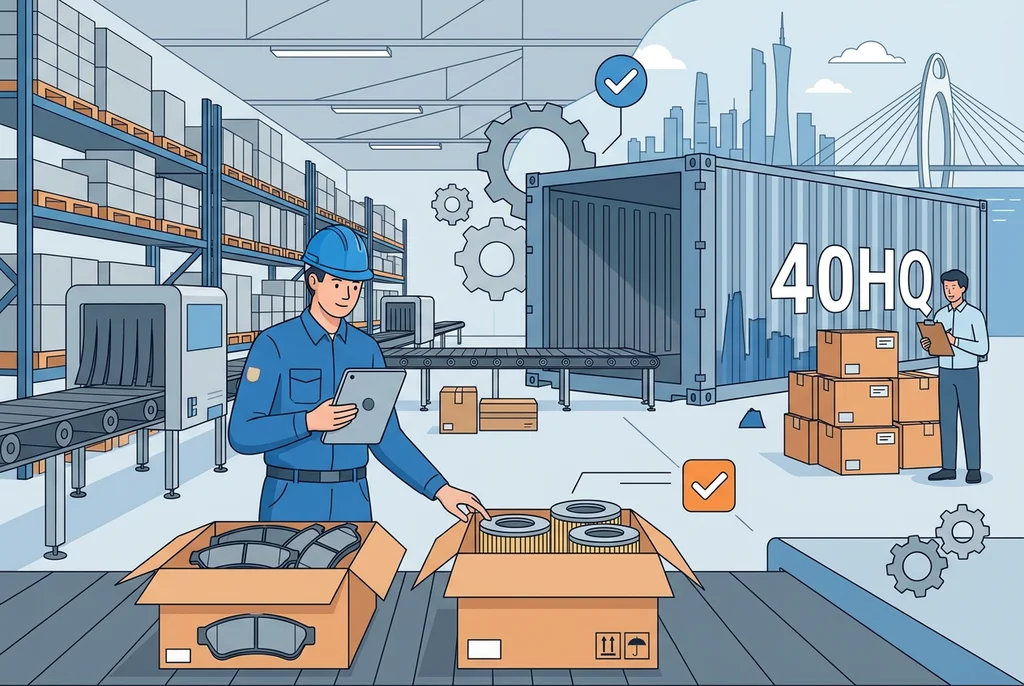
Quick Summary: Auto parts order fulfillment in China is the local execution work that happens after you already have suppliers, quotations, or a purchase list, and before your cargo leaves China. It means receiving goods from suppliers, checking what actually arrived, consolidating deliveries, preparing shipment information, and keeping the buyer updated through clear order status. For auto parts importers, fulfillment is not storage and not freight. It is the operating layer that turns scattered supplier goods into stock you can actually receive, trust, and sell.
The Buyer Usually Already Knows What to Buy
A serious auto parts buyer rarely arrives with an empty page. There are supplier links, 1688 pages, old factory names, WeChat contacts, quotations, and a purchase list with brake pads, filters, sensors, steering parts, or small electrical items already written down.
So if I define fulfillment as "helping you find products," I am starting too early.
Many importers are already past that stage. The product decision has been made. The supplier may already be selected. What they need now is not another supplier search. They need the order to happen correctly, completely, and on time.
That is the real line between sourcing and order fulfillment. Sourcing helps you decide who to buy from. Fulfillment starts after that decision and controls what happens next.
After Payment, the Order Stops Being Clean
Before payment, the order looks neat: a quote, a product photo, a few supplier promises, maybe a spreadsheet with OE references and quantities. Everything can still be discussed on a screen.
After payment, the order becomes physical. Cartons have to be packed. Domestic delivery has to happen. One supplier ships quickly. Another says the goods are ready but has not sent them out. Some cartons arrive with clear marks, and some arrive with almost nothing useful on the outside.
From outside China, the buyer sees fragments: a screenshot, a courier number, a photo of one carton, a message saying "ready." I do not treat that as order control. It only proves that something is moving somewhere.
Our work starts by turning those fragments into something the buyer can actually read: what arrived, who sent it, which order line it belongs to, what still needs checking, and whether it can move into the next shipment.
A Warehouse Address Alone Is Not Fulfillment
A China warehouse address is useful, but by itself it answers only one question: where can suppliers send goods?
It does not answer the questions that decide whether the order is healthy. Received what? From which supplier? How many pieces? Which SKU? Is the label clear? Does the carton match the order list? Should it join the next shipment, or should it be held back?
This is why I never call storage alone fulfillment. A real China warehouse service for auto parts importers has to connect every physical carton back to the buyer's purchase list. Space is easy. Control is the part the buyer actually needs.
The same gap exists with freight. A forwarder can book space and move cargo, but freight should start from a confirmed batch, not from a mixed pile of supplier deliveries that nobody has connected back to the real order. If shipping starts before this work is done, the buyer may only discover the problem after the goods arrive overseas. That is why we separate a China shipping agent vs order fulfillment partner.
Small Auto Parts Details Become Real Money Problems
Auto parts are full of details that look boring until they cost money.
A left/right position. A model number that is almost right. A label that does not match the buyer's warehouse system. A missing small accessory. A carton mark that makes sense to the supplier but means nothing to the buyer's receiving team.
These are normal order details, not dramatic stories. But if the buyer sells to workshops, distributors, or online customers, normal details turn into business problems quickly. A wrong or unclear part can be rejected on arrival. Mislabeled stock can sit in the warehouse as dead inventory. A shipment that cannot be received cleanly can delay the buyer's own customer, and in auto parts, customers do not wait forever.
When we check goods in China, the purpose is not to make the process look complicated. The point is simple: make sure the buyer can actually use the stock after it lands.
Where a Mixed Order Quietly Breaks
In a mixed supplier order, the weak point is often not one big disaster. It is several small unclear points appearing at the same time.
A typical order may have brake parts from one factory, filters still being packed at another, electrical parts from a trading company, and small items bought directly from 1688. Each supplier sees only their own goods. The buyer sees the full order in a spreadsheet, but that does not mean the buyer controls the physical movement inside China.
When cartons arrive at the warehouse, this is where the order starts telling the truth. One carton has no useful mark. One line needs label confirmation. A supplier sends the right category but the model reference is too close to another item. Another delivery looks complete from the outside, but the received quantity needs to be checked before it is allowed into the shipment.
None of that is visible from a courier number. We register the cartons, connect them to the supplier and order line, hold unclear items, ask for confirmation where needed, and only then prepare the confirmed goods for consolidation. This is not heroics. It is ordinary control at the point where the order can quietly go wrong.
Live Tracking Is a Record of Execution
If we run the China side of an order, the buyer should be able to see the work moving without asking every supplier every day.
Supplier shipped. Goods received. Quantity checked. Label unclear. Waiting for confirmation. Consolidated. Documents being prepared. Ready for handover.
That is how I think about Live Tracking and dashboard updates. It is not a software feature first. It is a record of what has already been done, what still needs a decision, and whether this shipment is actually ready to leave China.
For a buyer outside China, this visibility matters because decisions have to be made while the goods are still here. If one supplier is late, the buyer can decide whether to wait or split the shipment. If a label is unclear, it can be confirmed before export. If a carton has arrived but is not yet connected to the order list, it should not be counted as ready stock.
When You Actually Need Fulfillment
If the order is one supplier, one simple SKU, and direct shipment to a forwarder, the buyer may not need much local fulfillment support. I would not make this service sound necessary for every order.
But the situation changes when the order has many SKUs, several suppliers, repeated replenishment, urgent stock needs, unclear carton marks, or no reliable person in China to receive and check goods. At that point, messages and screenshots are not enough. The buyer needs physical execution: receiving, checking, sorting, consolidating, preparing documents, and handing over a shipment that actually makes sense.
That is what auto parts order fulfillment in China is for. It is not an extra layer added for decoration. It is the China-side operating layer that allows the buyer's purchasing plan to become usable inventory.
Send Us the Order You Already Have
You do not need to prepare anything new. If you already have supplier links, 1688 product pages, quotations, a purchase list, or a replenishment plan, send them through our Contact Form.
We can review the actual order structure and tell you what China-side fulfillment work is needed before shipment: receiving, quantity checking, packaging or label checks, consolidation, Live Tracking, export document coordination, and shipment handover. The first useful step is not a long sales call. It is looking at the real order list and deciding what must be controlled before the goods leave China.
FAQ
What is auto parts order fulfillment in China?
Auto parts order fulfillment in China is the local execution work between supplier payment and international shipment. It includes receiving goods, checking order details, consolidating supplier deliveries, preparing shipment information, and coordinating handover.
Is order fulfillment the same as sourcing?
No. Sourcing helps find suppliers, products, and prices. Order fulfillment starts after the buyer already has suppliers or purchase plans and needs a China-side team to execute the order.
Why do auto parts importers need fulfillment support?
Auto parts orders often involve many SKUs, several suppliers, labels, model references, and packaging details. A local fulfillment team makes those details visible and controlled before the goods are exported.
Can a freight forwarder handle order fulfillment?
A freight forwarder can move cargo, book freight, and handle shipping arrangements. They usually do not manage supplier follow-up, quantity checking, model confirmation, or consolidation decisions before the goods are ready.
How does Live Tracking help during fulfillment?
Live Tracking shows what has happened inside the China-side order: supplier status, received goods, checking progress, open issues, consolidation, and shipment readiness. It helps the buyer make decisions while the goods are still in China.
When should I use a China-side fulfillment partner?
Use one when you already have suppliers or orders in China but need local execution. It is especially useful for multi-supplier, multi-SKU, or repeat replenishment auto parts orders where goods must be received, checked, combined, and prepared for shipment.