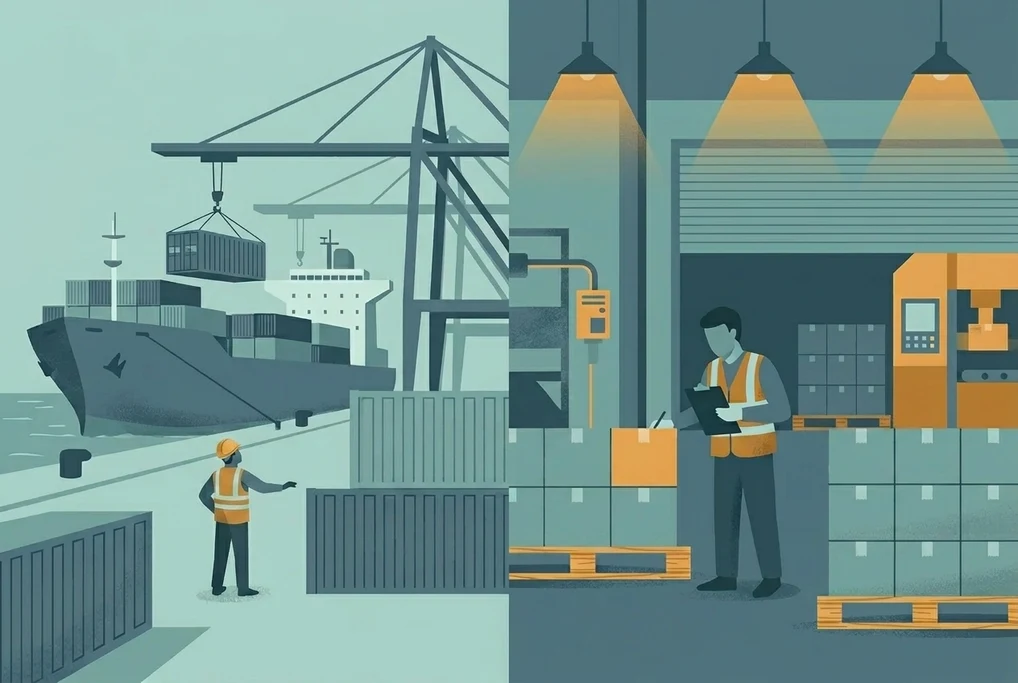
Quick Summary: A China shipping agent moves cargo after the goods are ready for freight. An order fulfillment partner controls the work that makes the goods ready: supplier follow-up, warehouse receiving, quantity checks, packaging checks, multi-supplier consolidation, problem records, and handover preparation. Auto parts importers often need both, but they should never assume one side is doing the other side's job. The most dangerous gap is the quiet period between deposit payment and freight pickup, when cartons are moving inside China but nobody may be checking whether the order is actually correct.
The Question Is Not Which Name Sounds Better
Many buyers ask this question too late.
The goods are almost ready. Several suppliers have sent domestic tracking numbers. A forwarder has asked for carton count and CBM. The buyer looks at the whole situation and thinks, "Maybe the shipping agent can handle it from here." Sometimes that is true. Many times, especially with auto parts, it is not.
A shipping agent and an order fulfillment partner sit next to each other in the same order timeline, but they do not own the same risk.
The shipping agent is responsible for freight. The fulfillment partner is responsible for the China-side execution before freight. If that sounds like a small difference, it is only because the problem has not happened yet.
Once one supplier ships short quantity, one carton arrives without a clear mark, or one model number is close but not correct, the difference becomes very clear.
What a China Shipping Agent Is Good At
A good shipping agent is valuable. I do not want to make this sound like a competition between two services.
Shipping agents arrange container booking, LCL or air freight, trucking to port, export documents, customs declaration, origin charges, and communication with the destination-side forwarder. Their job is to move cargo from China to the buyer's country.
That work starts when goods are ready to ship.
The problem is the word "ready." In supplier language, ready may mean packed in their warehouse. In a forwarder's language, ready may mean cartons can be picked up. In the buyer's business, ready should mean something stricter: the right goods arrived, the quantity was checked, visible packaging problems were recorded, carton marks make sense, and the shipment can be handed over without guessing.
A driver can collect cartons from three factories. That does not mean the order has been checked. A shipping agent may count boxes at pickup. That does not mean they compared the parts against the purchase list. If brake pads, filters, sensors, and small electrical parts are coming from different suppliers, carton movement is only one part of the story.
Freight work is not order accuracy work.
What an Order Fulfillment Partner Must Control Before Freight
An order fulfillment partner works in the middle part of the order. This is the part buyers often underestimate because it is not visible from outside China.
After the buyer pays suppliers, we follow the order supplier by supplier. Who has packed? Who has shipped domestically? Which tracking number belongs to which purchase line? Which cartons arrived at the Guangzhou warehouse? Which ones are still missing? Which supplier says "tomorrow" for the third time?
This is where auto parts order fulfillment in China is different from basic shipping support.
When cartons arrive, the work is physical. We register the supplier name, carton count, item line, received quantity, visible condition, label information, and problem notes. If the buyer's list says 20 pieces and only 18 arrive, the issue is not left for the destination warehouse to discover. If a carton has no side mark, we take photos and push for confirmation before it is mixed with other goods. If two part numbers look similar, we do not treat a nice supplier photo as proof.
This is not complicated work in theory. It is just easy to miss when nobody is assigned to own it.
For auto parts, small details become business problems. A wrong left/right position can create returns. A missing accessory can stop the buyer's customer from installing the part. An unclear carton mark can slow the buyer's warehouse later. A short shipment can make the buyer look unreliable to their own workshop or distributor customer.
That is why the job must happen before freight, not after arrival.
A Simple Order May Only Need Shipping. A Mixed Order Usually Needs More.
If a buyer orders one SKU from one reliable supplier, and that supplier ships directly to the forwarder with clear documents, a shipping agent may be enough.
I would not force fulfillment into that order.
The situation changes when the buyer has several suppliers, many SKUs, repeated small orders, or mixed aftermarket auto parts. One supplier ships early. Another delays. A third sends cartons but uses a different packing style from the last order. The buyer asks for updates, but each supplier only talks about their own goods.
Nobody naturally sees the whole order.
This is why a China warehouse service for auto parts importers cannot be just an address. The address receives cartons. The system behind the address decides whether those cartons are connected to the right order, checked, photographed when needed, and held when something is wrong.
A warehouse without execution control is only a place where confusion can collect.
Where Live Tracking Fits In
Buyers outside China should not have to ask every supplier the same question every day.
Has it shipped? Did the warehouse receive it? How many cartons came in? Which item is missing? Is the shipment complete now? Can the forwarder pick up?
Live Tracking matters because it turns warehouse work into visible order status. It is not a decorative dashboard. It is a practical record of what is happening before the cargo moves.
For a mixed auto parts order, the dashboard should show supplier status, received quantity, carton count, check result, problem notes, photos where needed, and whether each line is ready for consolidation. If one supplier is late, the buyer can decide whether to wait or split. If quantity is short, the supplier can still be pushed while the goods are in China. If labels are unclear, the buyer can confirm before export.
This is the part that makes a fulfillment partner different from someone who only says, "Send goods to my warehouse."
Handover to the Shipping Agent Should Be a Controlled Step
The handover point is where the two jobs meet.
Before cargo goes to the shipping agent, the fulfillment side should already know what is being handed over: final carton count, CBM if measured, supplier breakdown, problem lines closed or clearly noted, packing list information, marks, photos if required, and shipment readiness.
For multi-supplier orders, this is where auto parts consolidation in China becomes more than putting boxes together. Consolidation means deciding what can be shipped together, what should be separated, what needs repacking, and what information the shipping agent needs so freight can move cleanly.
If the shipping agent receives unclear cartons and a rough packing list, they can still ship. But the buyer is carrying uncertainty inside the shipment. That is not logistics anymore. That is business risk packed into a container.
How to Decide Which Service You Need
Before your next China order, do not ask only, "Who can ship this?" Ask, "Who owns the order before it is ready to ship?"
If suppliers are delivering directly to a forwarder, who checks received quantity? If one supplier is late, who records it and pushes for an answer? If a carton mark is missing, who fixes it before consolidation? If the purchase list has 40 small SKUs from different sellers, who connects each carton to each order line?
If those questions already have clear answers, you may only need a shipping agent.
If the answers are vague, you need China-side fulfillment before freight.
At BuyFromGuangzhou, this is the part we handle for auto parts importers: supplier follow-up, receiving, quantity and packaging checks, issue records, dashboard updates, consolidation, and handover preparation before the shipping agent takes over.
If the next question is what that China-side execution should cost, our China fulfillment agent cost guide explains the current fee scope and what remains separate before freight.
If you already have supplier links, quotations, or a purchase list, send them through our Contact Form. We can review the order structure and tell you whether it needs simple freight coordination or proper fulfillment control before export.
FAQ
What does a China shipping agent do?
A China shipping agent handles freight logistics after goods are ready to ship. This usually includes container or air freight booking, export documents, customs declaration, port delivery, and coordination with the destination-side forwarder. Their job is transportation, not line-by-line order checking.
What does an order fulfillment partner do before shipping?
An order fulfillment partner controls the work before freight: supplier follow-up, warehouse receiving, quantity checks, packaging checks, problem records, consolidation, and handover preparation. For auto parts importers, this is the step that confirms whether the goods are actually ready before the shipping agent moves them.
Can a shipping agent also check my auto parts order?
Some shipping agents offer basic receiving or carton counting, but that is not the same as fulfillment control. Ask exactly what they check, whether they compare goods against your purchase list, whether they record model numbers and shortages, and what happens if a problem is found before export.
When do I need both a shipping agent and a fulfillment partner?
You usually need both when your order involves multiple suppliers, many SKUs, unclear carton marks, repeated small purchases, or parts that must be checked before shipment. The fulfillment partner controls the China-side order execution. The shipping agent moves the confirmed cargo to your country.
Why is the period between deposit payment and freight pickup risky?
After deposit payment, suppliers start moving at different speeds. One may delay, one may ship short quantity, and another may pack goods without clear marks. If nobody checks and records the goods in China, those issues may only appear after arrival, when fixing them is slower and more expensive.
How does Live Tracking help in this process?
Live Tracking shows what has arrived, what is missing, which supplier is late, which cartons have issues, and whether the shipment is ready. It does not replace physical checking, but it makes the checking visible to the buyer before export.
Is a warehouse address enough for auto parts fulfillment?
No. A warehouse address only receives cartons. Fulfillment requires registration, quantity checking, packaging review, issue feedback, consolidation control, and clear handover records. Without that process, the buyer may only be moving unclear cartons from China to another country.