
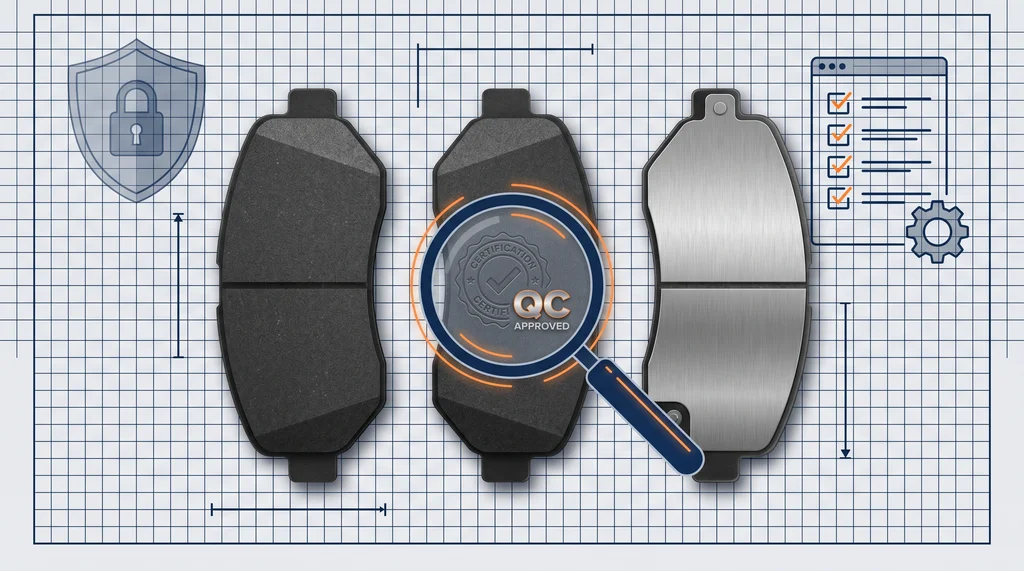
Quick Summary: Brake Pads from China: What European Buyers Need to Check Before Importing is not only a supplier question. For an importer, the real risk is what happens after payment: whether the goods match the order, whether cartons are clear, whether delays are visible, and whether someone in China checks the problem before export.
Last year a distributor in Europe lost €20,000 worth of inventory because the ECE R90 certificates his supplier sent turned out to be for a different friction compound. The paperwork looked correct. The pads were not.
This happens more than most buyers expect. Brake pads are the most requested item I handle, and the gap between a part that works and one that creates liability is smaller than it looks.
Most buyers check whether a certificate exists. Few check whether it matches the actual product.
ECE R90 Is the Floor, Not a Guarantee
If you are selling brake pads into the European aftermarket, ECE R90 is mandatory. It is the EU standard for replacement friction materials — the pad must be tested against the OEM equivalent and perform within a defined tolerance band for stopping distance and fade.
The problem is that ECE R90 certification can be faked, expired, or applied to a different product variant than what you actually receive. I have seen certificates issued to one friction compound shipped against orders for a different compound from the same factory. The paperwork said R90. The product was not the same one that got tested.
Before committing to an order, ask for the certificate and cross-check the approval number with the issuing body — TÜV, SGS, Intertek. A real certificate has a unique approval number that can be verified. If the supplier can only send a PDF and cannot provide the approval number, treat that as a red flag.
Price Tells You Something
Chinese brake pads for European cars generally run between $3 and $9 per set FOB Guangzhou, depending on vehicle type and friction formulation. Budget-tier pads for high-volume Korean or Japanese applications sit at the lower end. German car applications — BMW 3 Series, Audi A4, Mercedes C-Class — run higher because OE tolerances are tighter and friction compounds are more complex.
If a supplier is quoting $2 per set with ECE R90 on German applications, ask how. It is not impossible, but uncommon enough to require an explanation. Either the volume is very high, the certification is questionable, or the formulation is a compromise.
Four Things to Check Before the First Order
Beyond certification, there are four things worth verifying before confirming any brake pad order.
Friction coefficient. Ask for the mu value (μ). ECE R90 requires the replacement pad's friction coefficient stays within 15% of the OEM reference. A legitimate supplier can provide this from their test report.
Bedding-in documentation. Quality pads come with clear bedding instructions. If the supplier has nothing on this, they are probably not shipping to professional distributors.
Shim and hardware. Most European OEM applications require a shim for noise suppression. Some Chinese factories include shims, some do not. This affects your end customer's experience and any warranty claim that comes back.
Packaging and traceability. Each box should carry the OE reference, the ECE R90 approval number, a production batch code, and the factory name. If a batch has a problem, you need to pull it fast.
Volume and MOQ Reality
Brake pad MOQs from Chinese factories typically start at 50 to 100 sets per reference. Buying across 20 OE numbers is a serious inventory commitment before testing a single application.
The practical approach for a first order: pick the five applications that move fastest in your market, order 50 sets each, and run them through inspection before scaling. A pre-shipment check — even a spot check of 10 sets per reference — confirms physical dimensions and markings match the spec sheet.
One thing that catches buyers off guard: brake pads are classified as safety-critical components in some EU markets. If you are re-selling under your own label, make sure your supplier agreement includes a product liability clause and that you have documentation for every batch.
The Suppliers Worth Working With
The factories that consistently deliver to a verifiable standard are usually those with long-standing OEM supply relationships — Tier 2 or Tier 3 suppliers to European or Japanese vehicle programs. Their aftermarket lines carry real certification, not borrowed certificates.
The ones to avoid are trading companies one step removed from the factory that cannot answer technical questions about the friction formulation. If they cannot tell you whether the compound is semi-metallic, ceramic, or NAO, they do not know what they are selling.
Getting the first order right takes longer. The alternative — a recall, a warranty claim, a safety complaint — costs more than the entire margin on the batch.
If you are comparing whether you need supplier search or order execution support, read our guide on China sourcing vs order fulfillment. If the order already has suppliers but needs receiving, checking, consolidation, or shipment control, our article on auto parts order fulfillment in China explains the middle work. You can also see how we keep buyers updated through Live Tracking.
If you want us to look at your supplier links, quotation, packing list, or order plan, send it through our Contact Form. I can usually tell quite quickly whether the risk is supplier quality, quantity control, packaging, unclear labels, or shipment timing.
FAQ
What should I check before paying a Chinese auto parts supplier?
Before payment, check whether the supplier can confirm the exact part, quantity, packaging, delivery time, and carton marking. I also want to know who will check the goods after they leave the supplier, because many mistakes only become visible when cartons arrive at a warehouse.
Can a freight forwarder replace order fulfillment support?
Usually no. A forwarder can move cargo, but they normally do not own the commercial accuracy of the order. They may receive cartons without checking whether the part number, quantity, label, or packaging matches what the buyer actually ordered.
Why does Live Tracking matter for China auto parts orders?
Live Tracking matters because the buyer needs visibility before export. The useful questions are simple: what arrived, what is missing, which supplier is late, which carton has a problem, and whether the shipment is really ready to leave China.