
Quick Summary: Every order we handle gets counted. Every single line item. is not only a supplier question. For an importer, the real risk is what happens after payment: whether the goods match the order, whether cartons are clear, whether delays are visible, and whether someone in China checks the problem before export.
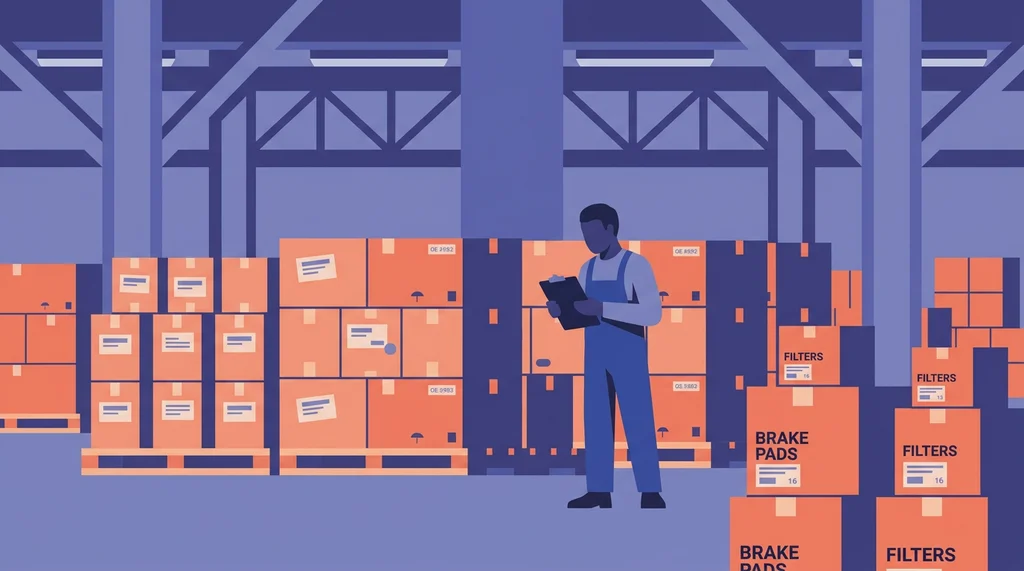
If the purchase order says 100 pieces, we count 100 pieces before anything moves. It does not matter if it is a set of brake pads or a small rubber boot worth two dollars. Everything gets counted, piece by piece, against the purchase order. That is the job.
We do this because short shipments are not the exception. They are routine. I have been doing this long enough to know that if we skip the count, something will be short. Not every time. But often enough that skipping is not an option.
The way it usually happens is not dramatic. A worker on a packing line seals a carton with 48 pieces instead of 50. A box gets separated from its batch during warehouse staging and ends up on a different pallet. Two part numbers with almost identical packaging get mixed up. None of this shows up on the factory's packing list. The packing list says 50. The carton has 48. Nobody at the factory catches it because nobody at the factory is counting finished goods against a customer order at that level of detail. That is not their job. It becomes our job.
When we catch a short shipment at the Guangzhou warehouse, we call the factory the same day. Not an email. A call. Emails give factories room to think about it. A call means we are dealing with it now. Most of the time, the factory has the missing units in their finished goods stock. They arrange a local courier to bring the top-up to the warehouse within 24 to 48 hours. The loading date stays on schedule. The buyer in Europe never knows it happened.
That is the best-case version. The worst-case version is when nobody catches the short shipment in China, and it travels across three weeks of ocean freight and shows up at a warehouse in Poland or the Czech Republic. At that point the buyer has already started pulling stock to fill their own customer orders. They are short. Their customer is waiting. And now they have to contact the Chinese factory from Europe, with a time difference, in a second language, to claim a shortage on a shipment that left China three weeks ago. The factory asks for photos. Then a re-count. Then they discuss whether it qualifies for a replacement or a credit note. A replacement shipment by sea takes another three to five weeks. A credit note helps the factory's relationship with the buyer but does nothing for the stock gap that exists today.
I have seen situations where we open a carton and the count is right, but the parts are wrong. Auto parts run on OE numbers. The OE number defines the fitment, the dimensions, the application. Two brake pads can look completely identical sitting in a carton and have different OE numbers, fitting different vehicle models. A factory running multiple part numbers in parallel sometimes pulls from the wrong bin. The outer carton label is correct. The parts inside are not. If that carton goes into the container without anyone checking the actual part number against the purchase order, it arrives in Europe as a useless box.
This is why we check OE numbers at the warehouse, not just quantities. If the number on the part does not match the number on the purchase order, the carton stays out of the container. The factory gets called, the correct stock gets confirmed, and the shipment waits. A one-day delay in Guangzhou is annoying. A container full of wrong-fitment parts arriving in Hamburg costs everyone months.
A freight forwarder does not do this. A forwarder collects the cargo, loads the container, and issues a Bill of Lading based on what the factories declared. They are not opening cartons. They are not counting pieces. That is not what they are paid to do, and it is not a criticism—it is just not their job. Moving the box is their job. Verifying what is inside the box before it moves is a different job entirely.
If you are sourcing auto parts from China and your only accuracy check on the China side is the factory's own packing list, you are asking the people who made the error to confirm there was no error. That gap is where short shipments and wrong items spend three weeks crossing the ocean before anyone finds them.
What does your receiving process look like on the China side?
If you are comparing whether you need supplier search or order execution support, read our guide on China sourcing vs order fulfillment. If the order already has suppliers but needs receiving, checking, consolidation, or shipment control, our article on auto parts order fulfillment in China explains the middle work. You can also see how we keep buyers updated through Live Tracking.
If you want us to look at your supplier links, quotation, packing list, or order plan, send it through our Contact Form. I can usually tell quite quickly whether the risk is supplier quality, quantity control, packaging, unclear labels, or shipment timing.
FAQ
What should I check before paying a Chinese auto parts supplier?
Before payment, check whether the supplier can confirm the exact part, quantity, packaging, delivery time, and carton marking. I also want to know who will check the goods after they leave the supplier, because many mistakes only become visible when cartons arrive at a warehouse.
Can a freight forwarder replace order fulfillment support?
Usually no. A forwarder can move cargo, but they normally do not own the commercial accuracy of the order. They may receive cartons without checking whether the part number, quantity, label, or packaging matches what the buyer actually ordered.
Why does Live Tracking matter for China auto parts orders?
Live Tracking matters because the buyer needs visibility before export. The useful questions are simple: what arrived, what is missing, which supplier is late, which carton has a problem, and whether the shipment is really ready to leave China.