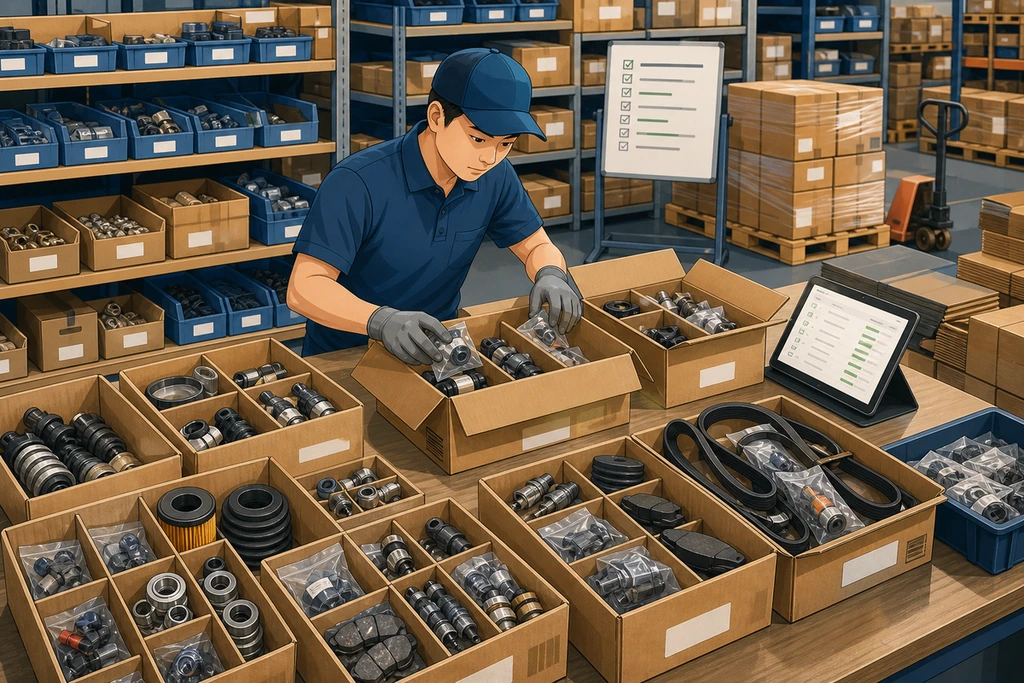
Quick Summary: Small batch auto parts fulfillment China is not mainly about finding more suppliers. It is about making a many-SKU buying plan physically workable once cartons start arriving from different factories and traders. When BuyFromGuangzhou handles this kind of order, we treat receiving, checking, dashboard updates, consolidation, and dispatch planning as one continuous execution chain, so the buyer can decide what ships now and what waits.
The pressure in these orders usually starts after payment, not before. One supplier sends brake sensors in two cartons. Another is still packing filters. A third says the steering parts are ready, but only part of the list is actually moving. If the buyer is running small replenishment volumes across many part numbers, the real question is not whether China can supply the goods. The real question is who is controlling the middle of the order while the goods are scattered across suppliers.
I do not see small-batch, many-SKU buying as a freight problem first. It is an execution problem first. Until someone in China matches cartons to order lines, checks what arrived, marks what is still missing, and decides what joins this shipment cycle, the buyer does not really have a shipment yet.
Many SKU orders break down in the middle, not at the sourcing stage
Buyers often already know what they want to buy. They have supplier links, old quotations, OE references, or a replenishment list from their own customers. The weak point comes later. Each supplier only sees their own line. Nobody naturally owns the mixed order after deposits are paid.
That is why a buyer who already understands auto parts order fulfillment in China usually stops asking only about warehouse space. A warehouse can receive cartons. A fulfillment team has to connect those cartons to supplier names, part references, quantities, issue notes, and the shipment plan the buyer is trying to maintain.
For small-batch orders, this matters even more because the shipment often cannot wait for perfect timing from every supplier. One line may be urgent. Another may be delayed. A third may need to be held because the label is unclear. The order needs real control in the middle, not only an address for delivery.
What we set up before the first carton arrives
If a buyer sends us a replenishment order with many SKUs, we do not wait for cartons to appear before organizing it. We first break the order into a supplier-by-supplier receiving sheet, item list, and dashboard record. I want to know which SKUs are urgent, which items can wait for a later batch, what packaging or label requirements matter, and what shipping direction the buyer is working toward.
That early setup is what makes later decisions possible. When the buyer is outside China, visibility cannot depend on memory or supplier chat history. The order needs a visible structure before the first supplier dispatches anything.
This is also why our Live Tracking view matters in a practical way. The dashboard should not only say delivered. It should show which supplier has sent goods, which cartons were received, which lines are under checking, which issues are still open, and whether the current batch is actually ready for consolidation or handover.
Receiving is where a mixed order becomes real
When cartons start arriving, the work is not just unloading and stacking. We attach each carton to the supplier and order line first. If the carton mark is unclear, it does not quietly enter the ready batch. We photograph it, hold it, and confirm what it belongs to before it joins anything else.
This sounds basic, but many-SKU orders become messy exactly because anonymous cartons get mixed into the pile too early. Once that happens, the buyer loses time asking simple questions that should already be answered: which supplier sent this, what part is inside, and does it belong to the current dispatch group or not?
For aftermarket auto parts, receiving also means looking at the practical identity clues that matter. We may check OE references where visible, connector shape or pin count for electrical items, left/right identity, packaging labels, or model markings that help us confirm the line. We do not pretend this replaces full technical testing. But we also do not release a line into the shipment just because a supplier says it is correct.
Door parts show why receiving checks matter for many-SKU orders
Door parts are a good example because one wrong line can look almost correct until somebody checks it against the buyer's real acceptance standard. I do not want our receiving check to stop at "the supplier label says this model." For these parts, we use a two-layer check before the line joins the ready batch.
The first layer is the OE number. We read the OE reference on the label, packaging, or part where it is visible, then match it to the buyer's order line as the identity code. The second layer is visual confirmation. We compare the part first with the buyer's verified reference image in their own system, because that image is already confirmed by the buyer and represents what the buyer expects to receive. After that, we cross-check the supplier's provided photo.
This second layer matters because suppliers can put the wrong label on the right part, or the right label on the wrong part. If we only check the number, we can miss a line that will fail when the buyer receives it. For a window regulator, we look at left or right side and mounting shape. For a mirror assembly, we check the housing, connector, and whether heating or folding function is involved. For a door switch or lock actuator, connector shape and pin count can decide whether the part is usable.
If the OE reference, buyer-verified image, and physical part do not line up, the line stays out of the current batch. We photograph the difference, update the dashboard status, and ask for confirmation before release. That is slower than blindly packing everything together, but it is what keeps a many-SKU shipment from carrying one hidden mistake all the way to the buyer's warehouse.
Small-batch buying only works when checked goods can be separated from unready goods
This is where many articles on small orders go wrong. They focus too much on price, MOQ, or freight. The harder part is deciding what is ready to move this week and what should stay out of the batch.
If one supplier ships the confirmed goods today and another is still missing two SKUs, the buyer needs a clean decision: wait, split, or replace. That decision is only useful if the China side has already marked which lines are received, checked, issue pending, or still missing. Without that status discipline, the buyer is making shipment decisions from incomplete chat updates.
We handle this as batch control, not guesswork. Confirmed lines can move toward consolidation. Unclear lines stay on hold. Short shipments, wrong labels, damaged cartons, or mixed specifications are recorded before the dispatch decision is made. That is the operating difference between a real fulfillment partner and a loose helper sending random photos.
This is also where a buyer comparing options should see the difference between a generic China auto parts consolidation service and one that can manage small-batch, many-SKU order control. Consolidation is not only putting cartons together. It is deciding which confirmed goods belong in the current shipment and which do not.
The dashboard should support shipment decisions, not only status curiosity
I usually judge a tracking system by one question: can the buyer make the next shipment decision from what it shows? If the board only proves that some cartons reached a warehouse, it is not enough for a many-SKU order.
For small batch auto parts fulfillment China, the useful statuses are practical: received, checking, issue pending, ready for consolidation, document preparing, ready for handover. The buyer should also be able to see supplier identity, carton count where relevant, photo evidence for abnormal lines, and what is still missing from the current batch.
That visibility changes the buyer's behavior. Instead of chasing every supplier for updates, the buyer can decide whether this week's urgent stock should go first by air, whether the slower heavy lines can wait for a later rail or sea batch, or whether the whole group should hold until one critical SKU is confirmed. The transport mode is not the whole story. The visible execution status is what makes route decisions rational.
Shipment rhythm matters more than one cheap shipment
For repeat aftermarket orders, the buyer is usually trying to keep stock moving, not win one isolated freight negotiation. A small-batch strategy can work very well, but only if the China side can repeat the same control cycle each time: receive, identify, check, separate, combine, document, and hand over.
That is why I do not like reducing this service to air freight alone. Some batches need speed. Some need cheaper consolidation. Some need the urgent lines moved first while the rest waits. The practical value is having one team in China that can organize the dispatch rhythm around the buyer's replenishment plan instead of forcing every order into one rigid route.
The same thinking also supports buyers who already use a China warehouse service for auto parts importers but still need more control. Storage alone does not solve multi-SKU replenishment. The useful part is the visible execution between arrival and dispatch.
What happens when one line is wrong or late
This is the real proof point. A supplier may send short quantity, the wrong voltage version, the wrong left/right side, or a carton with no clear mark. Another supplier may simply miss the promised dispatch date. In a small mixed order, one unresolved line can delay the buyer's whole stock plan if nobody owns the response.
Short quantity
If the received quantity is short, we compare the pieces or cartons against the buyer's order line and supplier delivery information. The dashboard status becomes shortage pending, with notes showing what arrived and what is missing. The buyer can ask the supplier to resend, accept a credit, wait for the missing quantity, or ship the confirmed goods first. The line closes only when the missing quantity is resolved or the buyer confirms that the batch can move without it.
Wrong item or wrong voltage version
If an electrical item arrives with a different voltage version, connector, function note, or visible reference from the purchase list, we hold that line before consolidation. The dashboard shows issue pending with photos and the suspected mismatch. The buyer can confirm whether the variant is acceptable, ask the supplier to replace it, or remove that SKU from the current dispatch. The closed result should be either released after confirmation, replaced by the supplier, or kept out of the shipment.
Wrong left or right side
Left and right parts cannot be treated as a small label detail. We check OE suffix, part-number marking, shape, mounting direction, and the buyer's verified reference image where available. If the side is not clear, the dashboard status stays held for confirmation. The buyer can compare the photo with their own system, ask the supplier to verify, or request a replacement. The part joins the batch only after the side is confirmed.
Carton without a clear mark
An unmarked carton does not go into the ready pile. We identify it through supplier name, courier record, carton photo, item appearance, and the buyer's order list. In the dashboard, the status stays unidentified carton or held, depending on how much evidence we have. The buyer can let us open and identify it, ask the supplier for packing details, or keep it separate until the source is clear. The closed result is a matched order line or a carton deliberately excluded from the batch.
Supplier delay
When a supplier misses the expected dispatch date, we record the promised date and actual status instead of letting the delay disappear in chat history. The dashboard shows supplier delayed or awaiting dispatch, and the buyer can choose to wait, split the ready goods, replace the delayed line, or move urgent SKUs first. The closed result is either received and checked, removed from this shipment cycle, or scheduled for the next batch.
When we identify a problem during receiving or checking, we mark it in the dashboard and separate it from normal goods, usually the same working day. After the buyer or supplier confirms the decision, we act as fast as the supplier or warehouse step allows. We prefer to show the real order status clearly instead of promising a fake fixed response time.
That handling logic is what makes small-batch replenishment sustainable. Without it, the buyer keeps paying for flexibility in sourcing but loses that flexibility again in execution.
What to send first if you want this setup
The best starting point is not a broad request for "fulfillment help." Send the supplier list, quotation or purchase list, urgent SKU notes, destination, and any packaging or label requirements that affect the shipment batch. If you already know which items can wait and which items should move first, that is useful input too.
Once we have that, we can set the receiving plan, open the dashboard records, track arrivals supplier by supplier, and build the dispatch batch around the goods that are actually confirmed. If you already have small-batch or repeat auto parts orders in China and want to check whether the execution setup is workable, send your SKU list or replenishment order through our Contact Form. We can review how the receiving, checking, consolidation, and dispatch rhythm should be structured.
FAQ
What is small batch auto parts fulfillment in China?
It is the China-side execution work that makes many-SKU auto parts orders physically manageable after purchase: receiving goods, checking what arrived, recording issues, consolidating confirmed lines, preparing shipment handover, and keeping the buyer informed through visible status updates.
Why is a warehouse address not enough for many-SKU auto parts orders?
A warehouse can receive cartons, but it does not automatically match them to suppliers, order lines, quantities, issues, and shipment decisions. Many-SKU orders need controlled receiving and visible execution, not only storage space.
What should a buyer see in the dashboard for this kind of order?
The buyer should see supplier identity, what has arrived, what is under checking, what is on hold, what is ready for consolidation, and what is actually ready for shipment handover. Photo evidence for abnormal lines is also important.
Can small-batch auto parts orders use more than one shipping mode?
Yes. The useful setup is not one fixed route. A China-side fulfillment team should be able to organize dispatch around the order plan, which may mean moving urgent lines first and holding slower or heavier goods for a later batch.
What happens if a supplier sends the wrong part or the wrong left/right version?
We hold that line first. Then we read the OE number and match it to the buyer's order line, compare the physical part with the buyer's verified reference image, and cross-check the supplier's photo. If the part does not match, we photograph the difference, mark the dashboard as held, contact the supplier for replacement or return, and release the line only after the decision is clear.
What should I send first if I already have suppliers in China?
Send the supplier list, quotation or purchase list, urgent SKUs, destination, and any packaging or label requirements. That gives the fulfillment team enough information to build the receiving plan and dispatch rhythm around your real order.