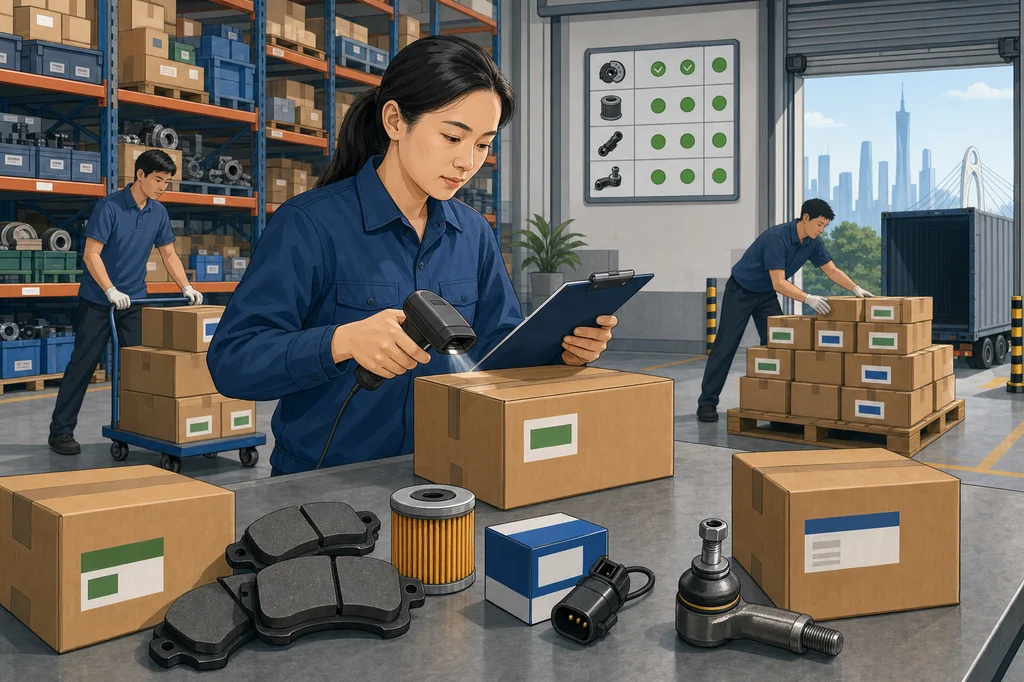
Quick Summary: A China buying agent and a purchasing agent may perform the same work because these titles are not used consistently. The useful comparison is not the job name but the written scope: supplier search, purchase placement, supplier follow-up, receiving, checking, issue handling, consolidation, documents and shipment handover. For a multi-SKU auto parts order, the work after payment usually decides whether separate supplier deliveries become usable stock. BuyFromGuangzhou handles that China-side execution with receiving records, visible checks, Live Tracking and controlled shipment preparation.
A buyer sends the same auto parts list to two service providers. One proposal says “China buying agent.” The other says “purchasing agent.” Both mention supplier communication and a commission. At that point, the titles look different, but the difficult part of the order is still hidden.
Who records each supplier line after payment? Who notices that one carton arrived without a mark? Who checks whether an electrical part has the expected connector and pin count? Who tells the buyer that three suppliers are ready but one urgent brake-pad line is still short?
This is the comparison I would make before choosing either agent. The name on the proposal matters far less than who owns the physical order between supplier payment and forwarder handover.
A China buying agent and purchasing agent can be the same thing
There is no reliable industry rule that makes every buying agent one type of provider and every purchasing agent another. Companies use “buying agent,” “purchasing agent,” “sourcing agent” and “procurement agent” in overlapping ways. A provider may use one title for search visibility while offering a much wider or narrower service in practice.
In ordinary proposals, a China buying agent often focuses on finding products, requesting quotations, communicating with suppliers and placing orders. A purchasing agent may sound more involved in purchase administration, supplier coordination or repeat procurement. That is a tendency, not a guarantee.
I would not hire from the title. I would ask for the operating boundary in plain language: does the fee end when the supplier accepts the order, or does the team remain responsible while goods move through China?
If the buyer still needs supplier discovery, our guide to what a China sourcing agent actually does for an auto parts order explains that earlier stage. This article starts at the harder decision: what happens when the suppliers have been chosen and the buyer needs the order executed.
The real difference appears after the purchase order
Before payment, the work is mostly information. There are links, quotations, MOQ discussions, specifications, payment terms and promised dates. After payment, the order becomes physical. Cartons leave different cities on different days. Similar parts arrive in plain packaging. One supplier sends all lines together; another sends a partial quantity and promises the balance later.
A purchase can be completed on paper while the shipment is still nowhere near ready. That gap is easy to miss when an agent reports “ordered” and then waits for suppliers to deliver to a warehouse or freight address.
For a mixed auto parts order, somebody must create a supplier-by-supplier working record before the first carton arrives. It should connect each supplier to the buyer's order line, expected quantity, OE or buyer reference where relevant, packaging or label requirement, promised dispatch date and shipment priority.
Without that record, receiving becomes guesswork. The warehouse may know that four cartons arrived, but not whether they complete the filter order, contain two different lamp sides, or belong to the urgent replenishment batch.
Compare the promised deliverables, not the agent title
When I review an agent proposal, I want to see specific outputs. “Supplier management” is too vague. “Quality control” is also too vague unless the provider explains what is checked, what evidence is recorded and what happens when a line fails.
A serious comparison should cover these questions:
- Will the team create and maintain a supplier-by-supplier order sheet?
- Will domestic shipment status show the promised date, actual dispatch and courier number?
- Will every arrival be matched to the supplier and order line rather than only stored?
- Which visible details will be checked: quantity, packaging, label, carton mark, OE reference, left/right clues, connector shape, pin count or voltage mark where relevant?
- How will shortages, wrong items, damaged packaging and unidentified cartons be photographed, recorded and held?
- Can the buyer see received, checking, issue pending, ready for consolidation and handed-over status before the cargo leaves China?
- Who decides what joins the shipment, what waits and what documents match the released goods?
Those answers reveal the service. A buying agent with a complete receiving and release process may be a better fit than a purchasing agent that only places orders. The reverse can also be true. Scope beats title.
Receiving must turn a carton into an identified order line
A delivery address is not an execution process. When a carton reaches Guangzhou, we first need to know which supplier sent it and which purchase line it is meant to complete. The domestic courier record, carton mark, supplier message and working order sheet should point to the same delivery.
If the outside mark is missing or unclear, the carton should not quietly enter the ready batch. We hold it and identify it through the courier record, supplier confirmation, photos, item appearance or the buyer's purchase list. That is slower than placing an anonymous box on a shelf, but it prevents confusion from being exported.
Under the agreed checking scope, the next step is to compare what arrived with the order. For auto parts, a product name such as “sensor,” “lamp” or “filter” is not enough. The useful evidence may be a visible OE number, buyer reference, left/right suffix, mounting direction, connector shape, pin count, 12V/24V marking, packaging label or verified reference image.
This is what controlled receiving from China suppliers should achieve: the buyer sees what physically arrived and which order line it completes. It is different from a supplier saying the goods were sent.
Issue handling shows whether the agent really owns execution
Normal orders are easy to describe. The useful test is what the agent does when the supplier sends short quantity, a wrong model, mixed left/right parts, damaged packaging or an unmarked carton.
Suppose the purchase list expects two electrical variants, but the cartons carry similar labels and one connector has a different pin count. We do not release both lines because the supplier says they are correct. The unclear line is held. The difference is photographed. The order record is updated, and the supplier or buyer is asked to confirm the next action.
The decision may be replacement, resend, return, credit, acceptance of the confirmed quantity, or moving the ready goods first. We act on the agreed decision as soon as it is confirmed. The important part is that the issue has an owner and a visible status; it does not disappear inside supplier chat.
A provider who only forwards supplier messages leaves the buyer managing the order remotely. A provider with issue notes, photo evidence, hold-and-release status and supplier follow-up is doing the physical work the buyer cannot do from overseas.
Live Tracking should support a shipment decision
A purchasing update such as “all ordered” is useful for one moment. It does not tell the buyer whether this week's replenishment batch can leave.
Live Tracking should show movement while the order is still in China: waiting for supplier, domestic shipped, received, checking, issue pending, ready for consolidation, document preparing, ready for handover or handed over. The dashboard can also carry carton count, issue photos, shortage notes and the buyer's release decision.
This visibility matters when suppliers move at different speeds. If filters and brake parts are checked but one sensor supplier is late, the buyer can decide whether to wait, split the shipment or move urgent stock first. The status board does not replace inspection. It makes the actual execution visible early enough for a commercial decision.
When I hear an agent promise “regular updates,” I ask what the buyer will actually see. Scattered messages are updates. A line-by-line dashboard connected to receiving, checking and release status is order control.
Consolidation starts with released goods, not stacked cartons
Several purchases do not become one shipment merely because their cartons reach the same address. Before consolidation, each line should have a clear status: confirmed, held, waiting for balance, repacking required, label pending or ready.
Only released goods should move into the outbound batch. At that point the team can confirm carton count, packing condition, required carton marks, urgent lines and whether the batch suits air, rail, sea or another agreed route. The packing list and related export information should follow the goods that were actually confirmed, not the quantities copied from old quotations.
Our China auto parts consolidation process treats consolidation as a controlled release step. The buyer should know what is inside the batch, what was deliberately held back and what still needs a supplier response before the next dispatch.
When a simple buying service is enough
Not every order needs a full operating team. If the buyer has one proven supplier, one simple product, clear export packing and a forwarder who receives shipment-ready cargo, a basic buying service may be enough. The buyer may be comfortable handling supplier communication and accepting the limited checking scope.
The need changes when an order has many SKUs, several suppliers, repeat replenishment, similar-looking variants, packaging or label requirements, staggered domestic deliveries or a planned shipment rhythm. In that situation, the buyer is not only buying. The buyer is running a small supply chain inside China.
That is where auto parts order fulfillment in China becomes the more accurate operating requirement. The service may still include purchasing, but its value is proven after the purchase: receiving, checking, issue control, consolidation, documents, status visibility and handover.
Ask for one written scope before choosing either agent
The safest selection method is simple. Send the same order scenario to each provider and ask for the same written scope. Include the number of suppliers, approximate SKU count, existing quotations or links, destination, urgent items, inspection limits, packaging or label needs and expected shipment timing.
Then ask what happens at each handoff: supplier confirmed, domestic shipped, received, checked, issue found, buyer decision, consolidated, documents prepared and cargo handed over. Ask what evidence you receive and who remains responsible at that point.
The best answer will not depend on whether the provider calls itself a China buying agent or purchasing agent. It will show a workable chain of ownership from purchase list to shipment-ready goods.
Send your SKU or replenishment list for execution review
If you already have auto parts supplier links, quotations, a 1688 cart, a SKU list or a repeat replenishment plan, send it through our Contact Form. BuyFromGuangzhou can review the China-side execution scope: supplier follow-up, receiving, visible checks, issue handling, Live Tracking, consolidation, export document preparation and shipping coordination.
The most useful inquiry includes supplier names or links, quantities, OE or buyer part numbers, urgent lines, destination, packing or label requirements and desired shipment timing. That lets us show which work is purchasing support and which work is required to turn the order into a controlled outbound shipment.
FAQ
What is the difference between a China buying agent and a purchasing agent?
The titles often overlap, and there is no universal industry definition that guarantees a different scope. A buyer should compare the written deliverables: supplier search, purchase placement, follow-up, receiving, checking, issue handling, consolidation, documents and shipment handover.
Does a China buying agent only find suppliers?
Some buying agents focus mainly on supplier search, quotations and placing orders, while others continue into receiving and shipping support. Do not assume the boundary from the title. Ask who controls the goods after the supplier dispatches them and what evidence the buyer can see.
Is a purchasing agent responsible for quality control?
Only if inspection or visible checking is included in the agreed scope. The buyer should define what will be checked, such as quantity, packaging, labels, OE references or connector details, and whether unclear goods will be photographed and held before shipment.
Who should receive goods from several Chinese auto parts suppliers?
A China-side team should match each arrival to the supplier and order line, record carton and quantity status, check agreed visible details and control what is released. A freight address that only accepts boxes does not give the buyer the same order-line visibility.
How can I compare buying agent proposals for a multi-SKU order?
Give each provider the same supplier and SKU scenario, then ask for the outputs at every stage after payment. Compare receiving records, issue handling, photo evidence, dashboard access, consolidation decisions, document preparation and handover responsibility rather than only comparing commission rates.
What should Live Tracking show before an auto parts shipment?
Live Tracking should show supplier status, domestic dispatch, receiving, checking, issue pending, release, consolidation, document and handover progress. It should help the buyer decide what can ship, what must wait and which supplier still needs action.