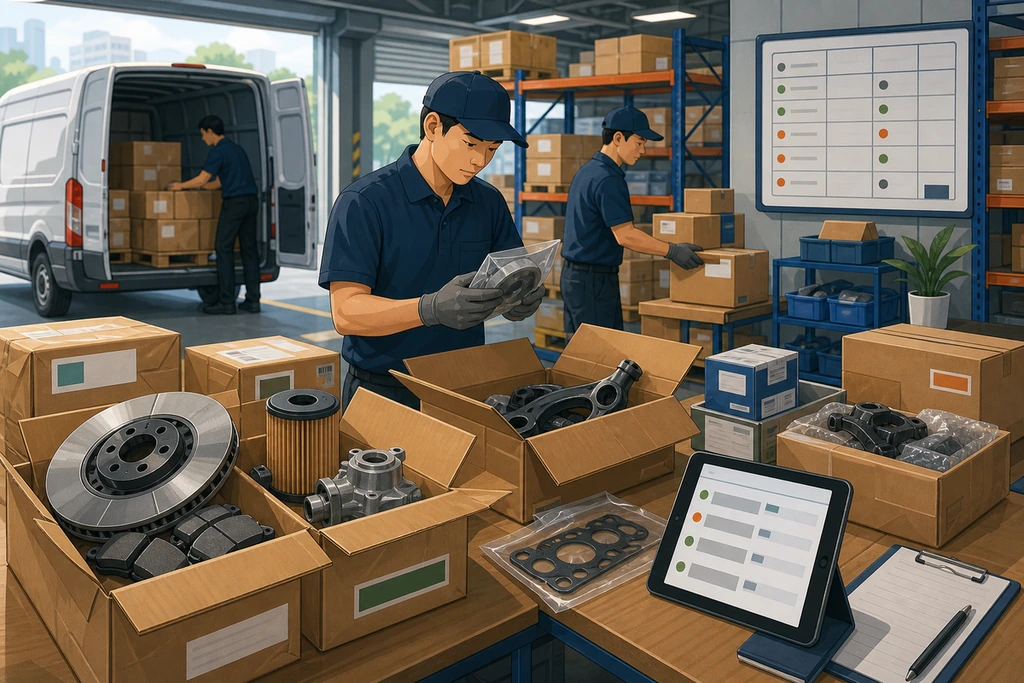
Quick Summary: You can keep your existing auto parts suppliers and hand the China-side fulfillment work to BuyFromGuangzhou. After you send the supplier links, quotations, or purchase list, we organize receiving, match cartons to order lines, check visible details, record and follow up issues, consolidate confirmed goods, and prepare a clear freight handover. Live Tracking shows what has arrived, what is held, and what is ready, so you do not have to manage scattered supplier updates from overseas. This is execution after supplier selection, not another supplier search.
Keep the Suppliers; Add One China-Side Fulfillment Owner
Many importers already have auto parts suppliers in China and want to keep them. They may have bought from the same factory before, saved 1688 links, kept a WeChat contact from a trade show, or accepted a quotation. Telling them "we can help you source" misses the real problem: nobody yet owns receiving, checking, issue handling, consolidation, and handover across those suppliers.
When I receive this kind of inquiry, I do not start by asking whether the buyer wants more supplier options. I first ask for the things that make the order executable: supplier links, quotation files, product names, quantities, urgent SKUs, destination, and whether the goods should move together or in batches.
That changes the work completely. If the buyer already knows what to buy, the next job is execution. Someone in China has to turn those supplier details into an order record, follow each supplier after payment, receive the goods, check what arrives, prepare the shipment, and keep the buyer updated. That is where auto parts order fulfillment in China begins.
Before handing over the order, buyers can review our China fulfillment agent cost guide to see what the current service fee covers and what remains separate.
First We Turn Supplier Links Into a Working Order Sheet
A supplier link is not an order record. A quotation is not a warehouse instruction. A WeChat message is not enough for receiving goods.
Before goods start arriving, we need to translate the buyer's scattered information into something the warehouse and fulfillment team can actually use. For a normal mixed auto parts order, that means building a supplier-by-supplier order sheet: supplier name, contact, product description, item photo or link, model or OE reference, ordered quantity, expected delivery method, buyer notes, and any label or packaging requirement.
This sounds basic, but it is where many orders become messy. A buyer may call one item "sensor A" while the supplier quotation uses a Chinese model description. A 1688 link may show several options on the same page. A supplier may quote one package unit but ship in another carton arrangement. For parts with OE references, we record the OE number expected on that order line. For left/right items, we record the side shown by the order line, OE suffix, part-number marking, or buyer-approved image. For electrical parts, we record the connector, pin count, voltage label, or function note where the buyer or supplier provides it.
If these details are not clarified before receiving, the warehouse may get cartons but still not know what they are supposed to represent.
So the first useful output is not a beautiful report. It is a usable order sheet that lets us answer a simple question when goods arrive: which supplier sent this, and which line of the buyer's order does it belong to?
The Practical Workflow We Use
If a buyer only hears "we can help you handle the order," that is not enough. I would also want to know how the order is handled. For an existing-supplier auto parts order, our work normally follows a clear chain.
First, we sort the buyer's supplier information into one working file. Supplier links, quotations, item names, photos, quantities, urgent lines, and shipping notes are not left as scattered messages. They become an order sheet we can use when goods arrive.
Second, we confirm the receiving plan. Each supplier needs to know where to send goods, what name or mark should appear on the carton, and whether the delivery should be connected to a specific buyer order. This small step matters because anonymous cartons are one of the easiest ways for a mixed order to become unclear.
Third, when goods arrive, we register them supplier by supplier. We do not only say "received." We record supplier name, carton count, arrival date, and the order lines the cartons appear to match. If a carton cannot be matched, it is not treated as ready.
Fourth, we check the visible details that matter for that order. For simple lines, this means counting pieces or cartons against the order line and checking whether the carton mark can be connected to the supplier. For OE-based parts, we read the OE reference on the label, packaging, or part where visible and match it to the buyer's order line. For left/right parts, we verify the side by OE suffix, part-number marking, shape, mounting direction, or buyer-verified reference image. For electrical parts, we compare connector shape, connector pin count, voltage label such as 12V or 24V, and function notes such as heated or folding where relevant. We do not pretend this is full laboratory testing; it is practical pre-shipment control.
Fifth, unclear items are held. A held item should have a reason: label unclear, quantity short, wrong mark, damaged carton, model reference needs confirmation, supplier delivery does not match the purchase list. The buyer should be able to see the reason instead of guessing.
Sixth, we build the shipment batch from confirmed goods. Some lines join the next shipment. Some wait for missing supplier goods. Some urgent items may move first. This is where fulfillment turns separate supplier deliveries into a shipment plan.
Seventh, we prepare the handover information: what is included, what is held back, carton count, basic shipment details, and document information needed for the shipping side. The forwarder should receive a clear batch, not a pile of mixed supplier problems.
Eighth, the dashboard keeps the buyer updated while this happens. The buyer should not need to ask every day whether the order has moved. The status should show the work: pending, received, checked, issue pending, confirmed, consolidated, documents preparing, ready for handover.
After Payment, Supplier Updates Are Not Enough
After the buyer pays, each supplier starts moving at their own speed. Brake pads may be packed quickly. Filters may still be waiting for stock. Sensors may come from a trading company that ships by domestic courier. Small 1688 items may arrive without a clean carton mark.
From outside China, the buyer receives fragments: a screenshot, a courier number, a photo of one carton, a message saying "ready." I do not treat that as control. It only proves that someone sent some information.
Control starts when the physical goods are connected back to the order sheet. When a carton arrives, we check which supplier sent it, register the carton count, attach it to the correct order line if possible, and mark the status. If the outside mark is clear, the work moves faster. If the mark is unclear, the carton does not simply disappear into a pile; it gets held until it can be identified.
This is the difference between communication and execution. Communication says the supplier shipped. Execution says what arrived, where it is recorded, what it matches, and whether it can move forward.
What Happens When Goods Arrive at the Warehouse
A warehouse address is only the entry point. The important work starts after the carton is received.
For auto parts, we usually look at several practical details before calling a line ready. Supplier name is checked against the dispatch message or courier record. Quantity is counted against the order line where the order requires piece-level confirmation, or carton count is recorded where the order is carton-based. Visible carton condition is photographed if there is damage. Model reference is compared with the purchase list. OE reference is read from the label, packaging, or part where visible. Left/right position is checked through OE suffix, part-number marking, shape, or buyer-approved reference image. For electrical parts, connector shape, pin count, voltage label, and function notes are compared with the order line or supplier photo where available.
Not every order needs a deep inspection. But every order needs clear receiving logic. A carton can be received but not checked. A line can be checked but not yet ready for consolidation. An item can be ready physically but waiting for the buyer to decide whether it should join the next shipment or wait for other supplier goods.
That is why a useful China warehouse service for auto parts importers should give more than storage space. It should create a traceable chain: received, identified, checked, issue pending, ready for consolidation, or ready for handover. Without those status differences, the buyer only knows that boxes exist somewhere in China.
How We Handle Supplier Problems Before They Become Buyer Problems
This is the part buyers care about most, and they are right to care. A China-side fulfillment team is not really tested when every supplier ships correctly and on time. It is tested when normal supplier problems appear: short shipment, wrong item, delayed dispatch, unclear labels, damaged cartons, or goods that arrive without useful marks.
Our working standard is simple: as soon as we identify an issue during receiving or checking, usually the same working day, that line should not move forward as normal cargo. It is marked on the dashboard, photographed as evidence, and separated from the ready batch until the buyer or supplier gives a clear decision. Once the agreed decision is confirmed, we act on it as soon as the supplier or warehouse step allows. I would rather show the real status clearly than promise a fake fixed response time.
When a supplier ships short quantity, we do not just write "received." We compare what arrived against the order line, mark the shortage, and keep that line open on the dashboard as a shortage issue. We photograph the received cartons, labels, packing evidence, or counted pieces where the shortage can be shown clearly. The buyer then gets real options: wait for the balance, ask the supplier to resend, accept a credit, or ship the confirmed goods first. The close-out is also recorded: balance received, supplier credit accepted, line shipped short by buyer approval, or line held for the next batch.
When a supplier sends the wrong item or a model reference does not match, the line is held. We compare the label, item photo, model number, OE reference, or visible feature against the purchase list. Then we upload photos of the label, product, connector, side marking, or visible mismatch and write the issue plainly: this is what arrived, this is what the order line requires, please confirm release, replacement, return, or supplier correction. If the buyer approves replacement, we contact the supplier and keep the line in issue status until the corrected goods arrive or the buyer decides to ship without that line.
When a supplier keeps delaying, the buyer needs more than "they said tomorrow." We record the promised date, the current supplier answer, and any domestic tracking evidence if the supplier claims it has shipped. The dashboard keeps that line in supplier pending or domestic tracking pending status, instead of quietly counting it as ready. If the ready goods are enough to form a useful batch, the buyer can choose to split the shipment and move confirmed stock first. If the delayed line is critical, the buyer may choose to wait, ask us to push the supplier again, or look for replacement supply. The close-out is simple: shipped and received, replaced by another supplier, cancelled/credited, or left for a later batch.
When cartons arrive with no useful mark, they are treated as unidentified until we connect them to a supplier and order line. We photograph the outside carton, shipping label, and any product label that can be seen, then check the courier record, supplier dispatch message, item appearance, and the buyer's order list. The dashboard status should not say "ready"; it should say something like "goods arrived, supplier/order line pending confirmation." Only after the carton is identified should it join the batch. This sounds like a small rule, but in a mixed auto parts order, anonymous cartons are where mistakes start.
When packaging is damaged or visibly abnormal, we photograph the carton before it is repacked or moved further. Then we classify the issue: outer carton only, product exposure risk, crushed packaging, wet carton, or missing accessory risk. If repacking is enough, we record that. If supplier replacement or confirmation is needed, the line stays held until the buyer or supplier decision is clear.
This is the difference between a team that only receives boxes and a team that controls an order. The buyer is not paying for someone to say "goods arrived." The buyer is paying for someone to notice when the goods that arrived are not yet safe to ship.
Door Parts Are a Good Example of How We Check Details
Door parts are a useful example because they look simple from a distance but often carry several variants: left/right window regulators, lock actuators, mirror assemblies with heated or folding functions, door control switches, different housings, different connectors, and similar part numbers.
When this kind of order comes in, the OE number is the first identity code. At receiving, we read the OE reference on the part, label, or packaging where visible and match it to the buyer's order line. If the OE number matches the order line, the part is usually very likely to be correct.
But we do not stop there, because one known supplier-side risk is a mislabeled part: the wrong label on the right part, or the right label on the wrong part. A number-only check can miss that. So we add a second layer. We compare the physical part against the buyer's own reference image first, because that image is already buyer-verified and represents the standard the buyer approved. Then we cross-check the supplier's provided photo.
For a window regulator, this may mean checking left/right orientation against the buyer-approved image and the part shape. For a mirror assembly, it may mean checking whether the housing, connector, and function note match the order line, such as heated or folding where the buyer has specified it. For a lock actuator or switch, it may mean checking connector shape and pin count against the supplier image or buyer reference.
When something does not match, the line is marked as held on the dashboard. We photograph the part, label, connector, and any visible mismatch. Then we contact the supplier directly with a plain message: this is the OE number received, this is what the order line requires, and this is the photo. Please confirm return, replacement, or correction.
For small-quantity 1688 items, this is usually not a big-cost problem when it is caught in China. If the supplier shipped the wrong item, the return or replacement is handled directly with the supplier before consolidation. I am not saying every supplier solves every issue perfectly, but in our experience, when the issue is described clearly with photos, it can usually be resolved before the wrong part crosses the ocean. That is the point.
A Mixed Supplier Order Needs One Local Owner
Several suppliers create a middle part that nobody naturally owns.
One supplier may deliver three cartons of brake parts. Another sends filters two days later. A small supplier sends electrical parts without a useful mark. A 1688 seller ships a small box that looks unimportant until the buyer realizes it contains the fast-moving small items their customer is waiting for.
In this situation, the question is not only whether each supplier shipped. The better question is whether all supplier goods have become one understandable order. Supplier name, order line, quantity, carton count, problem notes, and shipment status should be connected before the goods are handed to the shipping side.
This is why buying from multiple Chinese auto parts suppliers needs more than supplier follow-up. The suppliers do not coordinate each other. The forwarder usually moves cargo after it is ready. Someone still has to own the operating middle.
Live Tracking Should Show the Work, Not Just a Status Word
If the buyer already has suppliers, information can easily become scattered. One supplier answers on WeChat. Another sends a courier screenshot. A third confirms a quantity in a PDF quotation. The buyer may understand each message separately but still not know the full order status.
That is where Live Tracking and dashboard updates matter. But the dashboard should not only say "processing" or "delivered." Those words are too vague. It should show the work being done: supplier pending, domestic tracking received, goods arrived, quantity checked, label issue, waiting for buyer confirmation, consolidated, documents preparing, ready for handover.
For a buyer outside China, this is the difference between chasing and managing. If one supplier is late, the buyer can decide whether to wait or split the shipment. If one line is unclear, the buyer can decide before export. If the first batch is ready, the buyer can move stock instead of waiting for unrelated goods.
For example, if one door control switch is held because the connector pin count does not match the buyer-approved image, the dashboard should show that line as "label/model issue, waiting for confirmation," while the checked brake pads and filters remain marked ready for consolidation. The buyer can then decide: hold the whole shipment, replace only that switch line, or ship the confirmed goods first and leave the held line for the next batch.
This is how a fulfillment team proves reliability in practice. Not by saying "trust us," but by showing the work while it is happening.
Before Handover, the Batch Should Be Clear
A freight forwarder is important, but the forwarder should receive a confirmed shipment, not a mixed supplier problem.
Before handover, we want the buyer to know what is included in the batch, what was deliberately held back, which cartons were checked, which route was approved, and whether the shipment information matches the confirmed goods. If those details are unclear, the forwarder may still move the cargo, but the buyer is moving uncertainty together with it.
This is the difference between a China shipping agent vs order fulfillment partner. Shipping moves the cargo. Fulfillment prepares the order so the cargo is worth moving.
Why This Is Different From Finding Any China Helper
The buyer's real choice is not only "should I use someone in China?" The more important question is what kind of person or team owns the order.
A normal sourcing agent may be good at supplier communication and price discussion, but if they do not create receiving records, carton status, issue notes, and shipment batch decisions, the buyer may still be managing the order from overseas. A warehouse address may accept boxes, but if it does not match cartons to the purchase list, the buyer still does not know what the boxes mean. A freight forwarder may move cargo well, but moving cargo is not the same as confirming the order is ready.
Our advantage should be judged by the operating standard, not by slogans. Can the team turn supplier links into an order sheet? Can they register cartons supplier by supplier? Can they separate received, checked, held, and ready goods? Can they show the buyer what is missing and what decision is needed? Can they hand the forwarder a confirmed batch instead of mixed cartons?
If the answer is no, the buyer may still be doing the real management alone. If the answer is yes, the China-side team is not just helping with errands. It is operating the order.
What To Send Us First
If you already have auto parts suppliers in China, you do not need to start with a long introduction. Send what you already have through our Contact Form: supplier links, 1688 pages, quotations, purchase list, urgent SKUs, destination, and any shipment timing you are trying to meet.
We can look at the order structure and tell you what needs to happen next on the China side: how to organize the supplier list, what needs receiving, what should be checked, what can be consolidated, what should be tracked in the dashboard, and what should be ready before the forwarder receives the cargo. The first real question is simple: what part of this existing order needs to be controlled before it leaves China?
FAQ
Can I use BuyFromGuangzhou if I already have auto parts suppliers in China?
Yes. Many buyers come to us after they already have supplier links, quotations, or a purchase list. In that situation, the main work is not sourcing from zero, but executing the order in China.
What does a fulfillment team do after I send supplier links?
A fulfillment team turns the supplier links and quotations into a working order sheet, follows supplier preparation, receives goods, checks quantities and visible details, consolidates ready goods, and prepares shipment information. The exact scope depends on supplier count, SKU complexity, and shipment plan.
Do I still need sourcing if I already have suppliers?
Not always. If the suppliers and products are already decided, fulfillment may be the more important service. Sourcing answers who to buy from; fulfillment handles what happens after you decide to buy.
Can you receive goods from several Chinese auto parts suppliers?
Yes. Multi-supplier receiving and consolidation is one of the main reasons buyers use a China-side fulfillment team. Each supplier's goods should be registered, checked, and connected to the buyer's order list before shipment.
How does Live Tracking help when I already know my suppliers?
Live Tracking shows what is happening after supplier payment: which goods arrived, what was checked, what is missing, what is held for confirmation, and what is ready for consolidation or shipment. It gives the buyer one working view instead of scattered supplier messages.
What happens if a supplier sends the wrong part or the wrong left/right version?
We hold that line before consolidation. For auto parts with OE references, we read the OE number and match it to the order line, then cross-check the physical part against the buyer-verified image and the supplier's provided photo. If the side, connector, label, or model reference does not match, we photograph the issue, mark the line as held on the dashboard, contact the supplier for return or replacement, and only release the line after the decision is clear.
When should I contact a fulfillment partner?
Contact one before supplier goods start moving, or at least before they are handed to a forwarder. The earlier the fulfillment team sees the supplier list and purchase plan, the easier it is to arrange receiving, checking, consolidation, and shipment handover properly.