
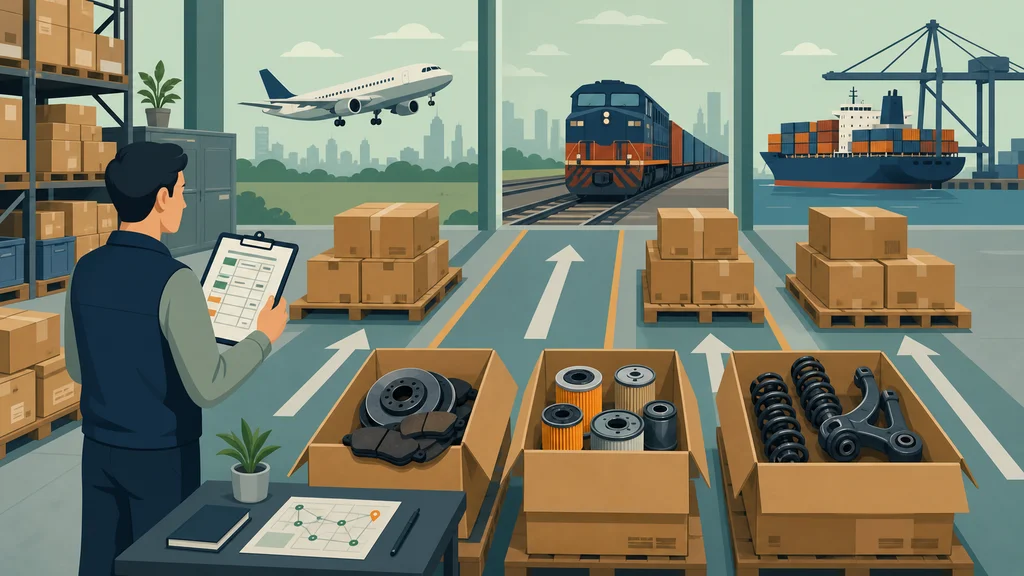
Quick Summary: Regular auto parts shipments from China should not start with the question of air, rail, or sea. They should start with the actual order status in China: what has arrived, what has been checked, what is still missing, and which parts the buyer needs for the next replenishment cycle. A fast route is useless if the urgent goods are not ready, and a cheap route is not cheap if it blocks stock the buyer needs this week. The real work is receiving, checking, separating, consolidating, and dispatching goods according to the buyer's stock plan, and only then choosing the route.
The Freight Question Usually Comes Too Early
Most buyers ask the freight question first: should this replenishment order go by air, rail, or sea?
I understand why. Freight cost is visible. Transit time is visible. When a buyer is short of stock, the route feels like the main decision. But when I look at a regular auto parts shipment, I do not start from the freight quote. I want to know what the order looks like on the floor in China, not only what it looks like in the buyer's spreadsheet.
The spreadsheet looks clean: brake pads, filters, sensors, suspension parts, electrical items, quantities, supplier names. But supplier goods almost never arrive in that clean order. Brake pads arrive first. Filters are promised tomorrow. The sensor supplier says the goods are packed, but no domestic tracking number has been sent. Suspension parts are ready, but they are heavy and not urgent. A small box from a 1688 seller arrives with a label nobody can match immediately.
At that moment, the right answer is not air, rail, or sea. It is too early to choose. First the buyer needs to know which goods are actually ready to become a shipment.
The First Job Is to Separate the Batch
For regular replenishment, the important work is not only receiving cartons. It is separating the order into goods that can move now, goods that should wait, and goods that need a decision.
Some goods are received and checked. Some are received but unclear. Some are still with the supplier. Some are ready but too heavy to justify fast freight. Some are urgent enough to move immediately once the quantity and label are confirmed.
If the buyer treats all of that as one shipment, one delayed supplier controls the whole order. The buyer may have enough confirmed parts to serve this week's customers, but those parts sit in China because another supplier has not finished a slower line. That is not a freight problem. It is a batch-control problem.
This is where auto parts order fulfillment in China earns its place. We are not only waiting for cartons to arrive. We are building a usable replenishment batch from whatever has actually arrived, been checked, and makes sense to ship, so the route decision sits on top of a confirmed batch, not a pile of supplier promises.
Once the Batch Is Clear, the Route Becomes Simple
Only after the batch is sorted does air, rail, or sea become a real decision. In practice, the choice usually follows three things: how urgent the part is, how heavy or bulky it is, and how much margin the line carries.
The mistake is choosing one route for the whole order. A single replenishment can often be split: urgent confirmed lines go by air, regular repeat stock follows by rail, and heavy parts wait for sea. The route is not one answer. It is a decision made per group of goods once we know what each group actually is.
A Mixed Air Shipment Can Waste Money Quietly
Here is a pattern I see often, with details generalized.
A buyer is short on brake pads and sensors and says, "ship it all by air, we need stock." But the same order also contains a pallet of suspension arms: heavy, not urgent, and not the kind of product that should pay for speed unless there is a real customer waiting for it.
The brake pads and sensors may deserve the air freight. The suspension arms usually do not. If the whole mixed batch flies just because part of it is urgent, the buyer may spend money on speed where speed does not help sales. The fix is not always a cheaper forwarder. Often it is separating the batch: air for the urgent lines this week, sea or another slower route for the heavy stock later.
Same suppliers, same warehouse, different decision. That is the difference batch control makes. Without it, "we need stock" can become "we paid fast freight on goods that could have waited."
The Warehouse Is Where the Shipping Plan Becomes Real
A warehouse address alone cannot run a replenishment plan. A supplier can deliver cartons to a warehouse and the buyer may still know very little about the real condition of the order.
Which order line is this carton for? Is the quantity complete? Are the carton marks usable? Has the item been checked? Can it join the next batch, or should it be held until the buyer confirms something?
This is why a China warehouse service for auto parts importers has to act as an order-control point, not only storage space. When goods arrive at our warehouse, we connect them to supplier name, order line, quantity, and shipment plan. If a label is unclear, it gets flagged. If quantity is short, the buyer knows before the batch is built, not after it ships. If the goods are ready, they are assigned to the next replenishment cycle.
Without that, regular shipments turn into repeated guessing.
Live Tracking Should Show the Batch Taking Shape
The buyer should not have to ask every supplier every day whether the next shipment is ready. The order dashboard should show the batch taking shape.
Supplier A delivered. Supplier B is still missing. Filters checked. One sensor carton waiting for confirmation. Brake pads ready for air. Suspension parts held for sea. Documents not started yet because the final batch is not confirmed.
That is the point of Live Tracking and dashboard updates: not to look modern, but to give the buyer a working view while decisions still matter. If one supplier is late, the buyer can decide whether to wait or split the shipment. If urgent goods are ready, the buyer can approve a faster dispatch. If a carton has arrived but has not been checked, the buyer knows not to count it as usable stock yet.
That is how visibility becomes practical reliability.
The Forwarder Should Receive a Confirmed Shipment, Not a Mixed Problem
A freight forwarder matters once the shipment is ready, but the forwarder should not be the first person trying to understand the order.
By handover, the batch should already be clear: what is included, what was held back, which route the buyer approved, what shipment information is ready, and whether the documents match the confirmed goods. Otherwise the forwarder is moving cartons while the buyer is still unsure whether those cartons match the replenishment plan.
This is the difference between shipping and fulfillment, which we cover separately in China shipping agent vs order fulfillment partner. For regular auto parts shipments, fulfillment prepares the batch. Shipping moves it.
The Real Goal Is Continuity
Regular shipments are not only about saving freight cost. What the buyer actually wants is continuity.
Stock should keep moving. Urgent lines should not wait for unrelated goods. Heavy parts should not be rushed without reason. Supplier delays should be visible early enough for the buyer to make a decision. If the buyer sells to workshops, distributors, or online customers, that continuity matters more than squeezing the cheapest route out of one shipment, because a customer who cannot get parts twice may look for another supplier.
Air, rail, and sea are only route choices. The real capability is receiving, checking, sorting, consolidating, updating, and handing over goods according to the buyer's stock plan. If that work is weak, regular shipments become repeated chasing. If that work is clear, the buyer can run small-batch replenishment from China with far less uncertainty.
Send Us the Replenishment Plan You Are Trying to Run
You do not need to prepare anything new. If you already have auto parts suppliers, quotations, a repeat purchase list, or a rough shipment plan, send it through our Contact Form. If there is one thing we need to know first, it is which SKUs are urgent and which ones can wait.
We receive supplier goods at our Guangzhou warehouse, check quantities and visible details, separate urgent lines from slower stock, consolidate ready goods, update your dashboard, and coordinate shipment by air, rail, sea, or a sensible combination. The useful first step is simple: look at the real list and decide what should move in the next batch.
FAQ
What is the best shipping method for regular auto parts shipments from China?
There is no single best method. The right route depends on what has arrived, what has been checked, what is urgent, and what can wait. As a rule of thumb, air fits urgent light or higher-value lines, rail fits steady repeat stock, and sea fits heavy or lower-margin parts, but only after the order status is clear.
Can one auto parts replenishment order use more than one route?
Yes, and it often should. Urgent confirmed goods can move by air while heavier or less urgent stock follows by rail or sea. This works best when the China-side team can separate goods by readiness and keep the buyer updated.
Why does fulfillment matter before freight booking?
Freight booking moves cargo; fulfillment confirms what cargo is ready. Receiving, checking, sorting, and consolidation should happen before the buyer chooses the route. Otherwise the shipping decision is based on incomplete supplier messages.
How does Live Tracking help regular replenishment orders?
Live Tracking shows which supplier goods arrived, what was checked, what is missing, and which batch is ready. It helps the buyer decide whether to ship now, wait, split the order, or change the route.
Can a freight forwarder manage this whole process?
A forwarder can arrange transport after goods are ready. It usually does not manage supplier follow-up, quantity checking, SKU readiness, or replenishment-batch decisions. Those belong to fulfillment before handover.
What should I send before asking for a regular shipment plan?
Send supplier links, your purchase list, urgent SKUs, quantities, destination, and timing requirements. With that, we can judge what should be received, checked, consolidated, and shipped in the next batch.